Blog

  • The 2025 ACA–PILIWA Moot Court Competition

    The 2025 ACA–PILIWA Moot Court Competition

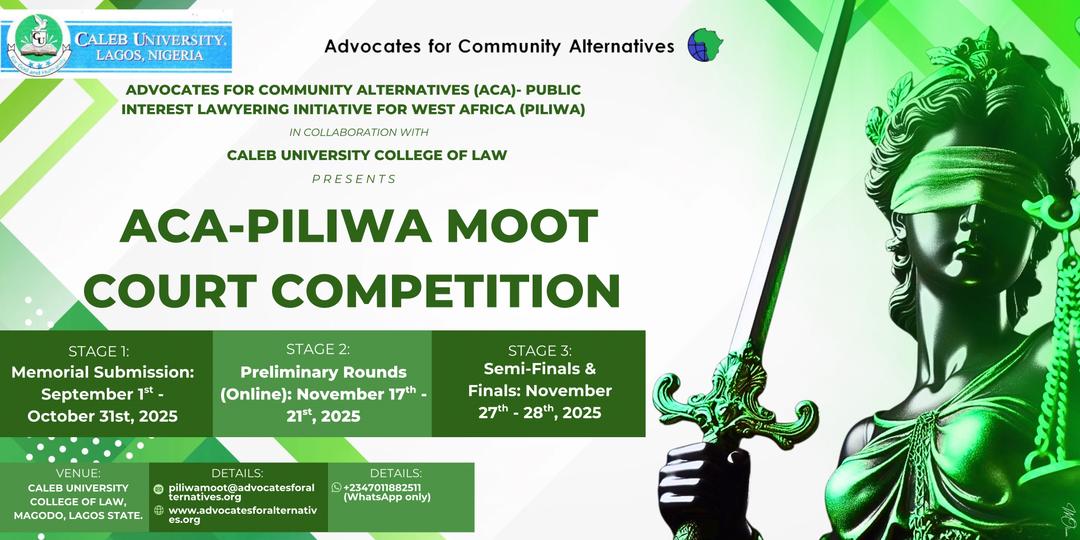
    Advocates for Community Alternatives (ACA)- Public Interest Lawyering Initiative for West Africa (PILIWA), in collaboration with the Caleb University College of Law, proudly announce the 2025 ACA–PILIWA Moot Court Competition.
    This year’s edition will take place in a hybrid format from November 17 to 28, 2025, bringing together some of the brightest law students across South-West Nigeria. The preliminary rounds will be held virtually, while the semi-final and final rounds will be convened in-person at the College of Law, Caleb University, Magodo City Campus, Lagos State, Nigeria.
    A total of ten universities are confirmed to participate in the preliminary rounds beginning Monday, November 17, 2025.
    The competition provides a unique platform to nurture the next generation of public interest lawyers, deepening their understanding of human rights and environmental law in Africa. It seeks to raise awareness on pressing human rights issues, highlight the relevance of regional and international human rights instruments, and equip students with practical advocacy and legal reasoning skills vital for impactful legal practice.

    Through this initiative, Caleb University, ACA and PILIWA reaffirm their commitment to strengthening public interest lawyering and promoting social justice across the continent.

  • ACA invests $240,000 in development projects across 30 Fanteakwa South communities

    ACA invests $240,000 in development projects across 30 Fanteakwa South communities

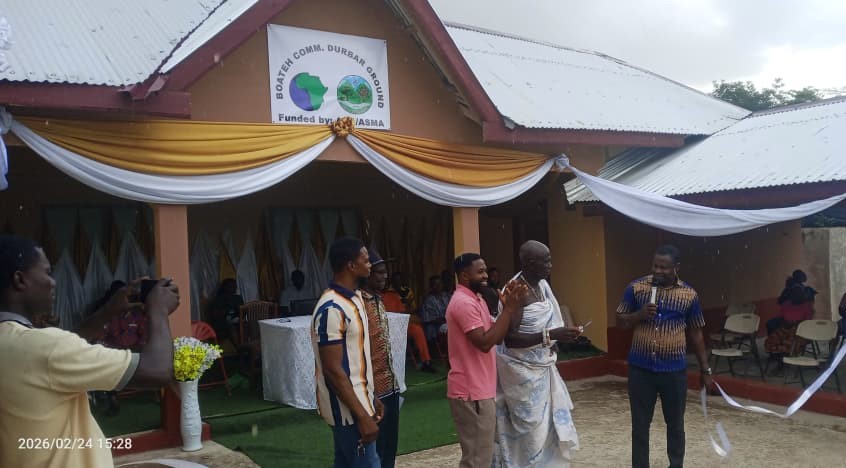
    Advocates for Community Alternatives (ACA), an Accra-based international non-governmental organization, has injected $240,000 into various development initiatives across 30 communities in the Fanteakwa South District of the Eastern Region over the past five years.

    According to Nana Ama Nketia-Quaidoo, ACA’s Director of Community-Driven Development, each of the 30 beneficiary communities received $8,000 from ACA, with the Fanteakwa South District Assembly contributing an additional $1,000 per community.

    Beneficiary communities include Juaso, Nsuapemso, Saamang, Abompe, Bosuso, Subrima, Nsutam, and Nsuta-Dahomey, among others.

    Range of projects

    Speaking at a Town Hall Meeting organized by the District Assembly at Saamang near Osino, Mrs. Nketia-Quaidoo highlighted that the projects undertaken include:

    • Three (3) clinics
    • Thirteen (13) mechanized boreholes
    • Seven (7) school blocks
    • Two (2) teachers’ bungalows
    • A poultry farm
    • Two (2) black soap production centers
    • A bridge
    • A concrete road
    • a market centre
    • Electricity extension to two communities and
    • Two community centers

    She commended the chiefs and people of Saamang, Subrima, and Nsuta-Dahomey for their exceptional communal spirit, which she said greatly facilitated the speedy implementation of their respective projects.

    “These are communities whose cooperation and commitment have been exemplary,” she said, urging other communities to emulate their example.

    Mrs. Nketia-Quaidoo also advised local leaders to properly document lands earmarked for development to prevent future disputes and encouraged constructive collaboration among opinion leaders to ensure continuity in development efforts.

    “Development is not about positions or personal interests — it’s about continuity and shared responsibility,” she emphasized.

    She further noted that accountability should be a two-way process, calling on citizens to not only demand transparency from authorities but also play their part responsibly in community development. She urged traditional leaders to periodically hold accountability sessions with their people.

    Continuity

    In her remarks, Mercy Akosua Korang, the District Chief Executive (DCE) for Fanteakwa South, assured residents that the government remains committed to completing all ongoing Agenda 111 hospital projects across the country.

    She said the government is currently reviewing the contractual agreements for the projects and will resume work soon.

    “Governance is a continuous process. The Agenda 111 projects will not be abandoned — they will be completed for the benefit of all,” she assured.

    Responding to a question about the status of the Agenda 111 project at Nsuapemso Junction, the DCE confirmed that construction would soon resume and appealed for public confidence in the government’s commitment to deliver.

    Ongoing District Projects

    Mrs. Korang further disclosed that several development projects are underway in the district, including road construction works, the establishment of two new CHPS compounds renovation and construction of school blocks, installation of additional mechanized boreholes

    She appealed for continued cooperation from chiefs and residents to ensure the smooth execution of these projects.

    Officials from the Assembly — including the District Coordinating Director, Budget Analyst, Planning Officer, Works Engineer, and a representative of the Member of Parliament — also addressed the gathering.

    Equitable Development

    Barima Dr. Ofori Nyarko Tetepo II, the Chief of Saaman, who chaired the meeting, commended the Assembly for engaging citizens and promoting accountability. He, however, urged authorities to ensure a fair distribution of development projects across the district.

    He also proposed the establishment of a major market center to boost local commerce, offering 20 acres of land for the initiative.

    “A central market will enhance trade and open up economic opportunities for our people,” he said.

  • MAPO and NMJD Renew Call for Justice Over Koidu Mining Abuses in Sierra Leone

    MAPO and NMJD Renew Call for Justice Over Koidu Mining Abuses in Sierra Leone

    A press conference held in Freetown, Sierra Leone, last Friday brought together members of the Marginalized Affected Property Owners Association (MAPO), their legal representatives, and senior officials of the Network Movement for Justice and Development (NMJD), to renew calls for justice for mining-affected communities in Kono District.

    The event highlighted years of alleged abuse, injustice, and environmental destruction linked to the operations of Koidu Limited, a diamond mining company operating in eastern Sierra Leone.

    Voices from the Affected Communities

    MAPO Chairlady, Mrs. Sia Janet Bayoh, delivered an emotional account of her community’s ordeal and described how Koidu Limited forcefully seized their lands and flooded her home to compel her family to relocate.

    “We were moved to a new place without water, without schools, without a clinic,” she said. “They call it resettlement, but it was more like abandonment.”

    Mrs. Bayoh also recounted how frequent blasting by the company, often done without notice, damaged their houses and endangered lives. “My own son’s head was seriously injured by a flying rock,” she said tearfully, accusing Koidu Limited of refusing to take responsibility for the incident.

    MAPO Chairman, Mr. Tamba Prince Boima, spoke of the “monumental destruction” caused by mining activities to their farms, rivers, and livelihoods. He detailed a pattern of intimidation, bribery attempts, and undue pressure from company agents, government officials, and traditional authorities aimed at silencing their movement.

    “They tried to buy our conscience,” Boima said. “But we refused. We are poor, but we are not for sale. We will continue this fight for justice — for our land, our children, and our dignity.”

    Painful journey

    NMJD’s Executive Director, Mr. Abu Brima, reflected on the long struggle for justice within Sierra Leone’s mining sector, describing it as “a painful journey of resistance, deceit, and systemic failure.”

    He recalled NMJD’s early interventions, including research conducted with Partnership Africa Canada (now IMPACT), which established the link between the country’s decade-long civil war and the illicit diamond trade.

    Mr. Brima emphasized that the findings of that research inspired the creation of the Kimberley Process Certification Scheme (KPCS), a global initiative aimed at preventing conflict diamonds from entering the mainstream market and ensuring that diamond revenues contribute to community development.

    However, he lamented that “despite Sierra Leone’s participation, the objectives of the Kimberley Process have been betrayed by persistent injustice, exploitation, and government complicity.”

    Failures of Accountability and Governance

    Mr. Brima accused Koidu Limited of consistently violating national laws and community rights and stated that the company’s non-compliance with social and environmental obligations triggered MAPO’s ongoing court case.

    He also criticized the World Bank for what he described as “biased interventions” through its Multilateral Investment Guarantee Agency (MIGA), arguing that their involvement was designed to protect corporate interests rather than national welfare.

    The NMJD Director further condemned the role of certain local chiefs, alleging that they had become “beneficiaries” of the company’s operations and had turned a blind eye to the suffering of their people.

    He also recounted two fatal incidents in Kono involving state security forces and protesting residents.

    In December 2007, two demonstrators were shot dead during a peaceful protest against Koidu Holdings. The subsequent Jenkins Johnston Commission of Enquiry found the company guilty and issued 17 recommendations — none of which were ever implemented. Five years later, in a similar protest, two more lives were lost, yet justice was again denied.

    “Every year, government officials attend Kimberley Process meetings abroad and present deceitful reports of compliance,” Mr. Brima said. “But if there were real compliance, these injustices wouldn’t persist.”

    Judicial Delays and Obstacles

    The speakers also described the slow pace of justice, citing repeated changes in court venues, long adjournments, and missing case files — challenges that have prolonged their legal struggle for years. These obstacles, they said, have drained the affected families emotionally and financially, but their resolve remains firm.

    Landmark judgment

    Dr. Chernor M. Benedict Jalloh of C&J Partners and Lead Counsel for the plaintiffs all residents of Kono District told the media that Court of Appeal of Sierra Leone has delivered a landmark judgment in the case of Aiah Fengai & 73 Others v. Octea Limited & Others, overturning a 2022 High Court decision that had dismissed the plaintiffs’ claims for lack of jurisdiction.

    He said the ruling, announced by a three-member panel led by Justice Fynn, found that the High Court erred in law when it denied the plaintiffs legal standing to sue, and further granted an interlocutory injunction freezing the defendant companies’ assets pending trial.

    The case, according to Dr. Jalloh, was filed by 74 class plaintiffs, 14 additional class plaintiffs, and nine individual plaintiffs — all residents of Kono District — who allege that Octea Limited’s mining operations caused extensive environmental destruction, unlawful deprivation of property, economic displacement, and emotional distress.

    He explained that their multiple suits were consolidated into one action at the High Court but struck out in October 2022 on the grounds that the plaintiffs lacked the capacity to sue and were not parties to any relevant contracts.

    Dr. Jalloh further said the trial judge failed to acknowledge their property and personal rights protected under law, even on customary lands owned by traditional chiefs.

    “The plaintiffs therefore challenged the court’s insistence that they exhaust a non-functional corporate grievance mechanism before seeking judicial redress. The Court of Appeal agreed, holding that damages for personal injury, property loss, emotional harm, and environmental nuisance were valid claims”, the Lead Counsel added.

    “In a decision hailed as groundbreaking, the Court affirmed that residents of customary lands have the right to sue for violations affecting those lands, even when legal title rests with local chiefs. Drawing inspiration from Ghanaian jurisprudence, the Court stated that restricting such rights to chiefs alone “would be absurd,” adding that traditional authorities are not immune from accountability.”

    According to him, the ruling allows the case to proceed to trial at the High Court and sets an important precedent in Sierra Leone’s legal history. It broadens access to justice for communities impacted by extractive industries and establishes, for the first time, that citizens can bring human rights–related lawsuits against multinational corporations for abuses tied to mining and environmental harm.

    A Call to Action

    The press conference concluded with a renewed appeal to the Government of Sierra Leone, the international community, and civil society actors to take decisive action to ensure accountability in the mining sector and protect the rights of affected communities.

    “Justice delayed is justice denied,” Brima stated. “The people of Kono have waited too long. It is time for the government to act, not to protect corporations, but to defend its citizens.”

  • Court of Appeal Overturns High Court Ruling in Landmark Human Rights and Environmental Case

    Court of Appeal Overturns High Court Ruling in Landmark Human Rights and Environmental Case

    The Court of Appeal of Sierra Leone today delivered a significant judgment in the matter of Aiah Fengai & 73 Others v. Octea Limited & Others, overturning a prior High Court decision that had struck out the plaintiffs’ claims for lack of jurisdiction.

    In a unanimous ruling delivered by a three-member panel of Justices of the Court of Appeal presided over by Justice Fynn, the Court found that the High Court had erred in law when it ruled that the plaintiffs lacked the legal standing (locus standi) to bring the case and granted an interlocutory injunction freezing the companies’ assets.  The case will now return to the High Court for trial.

    Background

    The case involves 74 plaintiffs, all residents of Kono District, who had initially filed multiple writs of summons against Octea Limited and other associated parties, alleging a wide range of environmental, economic, and personal harms arising from the defendants’ mining operations. These claims included allegations of unlawful deprivation of property, environmental degradation, economic displacement, and emotional distress. The writs were consolidated into one action at the High Court.

    However, on 27th October 2022, the High Court struck out the consolidated action, holding that it lacked jurisdiction to hear the matter on the basis that the plaintiffs had no legal capacity to sue, and were not privy to any contract that would entitle them to claim under the relevant mining and environmental laws.

    Appeal and Findings

    Dissatisfied with that decision, the plaintiffs, represented by C and J Partners, with Dr. Chernor M. Benedict Jalloh as the Lead Counsel, sought and were granted leave to appeal to the Court of Appeal. The appeal was based on several key errors in the High Court’s decision, notably:

    • Failure to recognize that many of the plaintiffs’ claims arose from personal damages (rather than contractual claims) for which legal standing could not be denied.
    • Failure to recognize that plaintiffs had property rights that were protected under law, even if the ownership of their land was vested in traditional Chiefs.
    • The need to extend Sierra Leone law to recognize universal standing to enforce environmental rights and obligations.
    • Unwarranted imposition on the plaintiffs of an obligation to use an internal corporate grievance mechanism before coming to court, despite recognition that the grievance mechanism was not actually functional.

    After careful consideration of all the submissions, the Court of Appeal issued a judgment that resoundingly vindicates the plaintiffs’ rights to justice for the harm they suffered.  Quoting the famous maxim that: “where there’s a wrong there must be a remedy,” the Court criticized the trial judge for striking out all the plaintiffs’ claims and held that damages for personal injury, property deprivation, emotional harm, and nuisance (environmental harms that affect residents’ peaceful enjoyment of their property) could go forward.

    Breaking new legal ground, the Court of Appeal also concluded that the plaintiffs had the right to sue for violations of the rights they hold to the traditional lands they inhabit, even if those lands belong to the Chiefs by law.  Noting that giving Chiefs the exclusive right to account for the land their subjects occupy “does not sit easily on our mind,” and giving credit to the courts of Ghana for recognizing the same principle, the Court decided that residents of customary lands should be able to sue for infringements on that land when their Chiefs decline to do so.  “Monarchs are now seldom found to be absolute, and their conduct comes under scrutiny regularly the World over.  It is our opinion that the attempts to make the right to sue or be sued with respect to customary land exclusive to the chiefs have lost its allure … We opine that to hold anything to the contrary would be absurd.”

    The Court also criticized the trial court for accepting unsubstantiated arguments that agreements between the Chiefs and the company had deprived the plaintiffs of their right to sue, and for requiring the plaintiffs to use Octea’s corporate grievance mechanism without giving them the chance to prove that the mechanism was inoperative.

    Finally, the Court granted an interlocutory injunction, extending the interim freezing order that it had imposed on the companies’ assets until a final judgment in the case is reached.  The Court recognized that this measure was necessary to prevent the company from stripping its assets from Sierra Leone in advance of the trial.

    Implications

    This decision paves the way for the plaintiffs to return to the High Court and have their claims fully heard on their merits. It marks a significant development in access to justice for affected communities in resource-rich regions and expands the scope of legal standing for land rights claims on customary lands in Sierra Leone.

  • Second mangrove planting strengthens climate resilience in Niafrang, Senegal

    Second mangrove planting strengthens climate resilience in Niafrang, Senegal

    Advocates for Community Alternatives (ACA) has successfully supported the second community-led mangrove planting in Niafrang, Senegal, as part of its ongoing efforts to promote environmental restoration and climate resilience across West Africa.

    This year’s exercise brought together residents, traditional leaders, and youth groups from Niafrang and neighboring communities such as Kabadio and Abéné, who joined hands to plant hundreds of mangrove seedlings along the Niafrang shoreline.

    The activity forms part of ACA’s broader initiative to restore degraded coastal ecosystems, enhance fisheries, and strengthen natural protection against coastal erosion and flooding caused by climate change.

    “Community-led restoration lies at the heart of ACA’s mission,” said Dr. Kwabina Ibrahim, ACA’s Science Lead. “By engaging youth from neighboring communities, we are helping to build a stronger, united front for environmental stewardship across the Casamance coastline.”

    This second mangrove planting builds on the success of previous efforts and reaffirms the community’s commitment to sustainable environmental management. The project reflects ACA’s ongoing collaboration with local partners to advance community-driven conservation and sustainable development in the region.

    Together, we grow a greener and more resilient Niafrang, Senegal.

  • ACA Partners Kaeme Cosmetics and Bohten Eyewear to Mark World Sight Day in Akyem Juaso

    ACA Partners Kaeme Cosmetics and Bohten Eyewear to Mark World Sight Day in Akyem Juaso

    As part of this year’s World Sight Day celebrations, Advocates for Community Alternatives (ACA), in partnership with Kaeme Cosmetics and Bohten Eyewear, organized a comprehensive skincare and eye health outreach program on Wednesday, October 8, 2025.

    The event, held at Juaso in the Fanteakwa South District of Ghana’s Eastern Region, brought together residents of ACA’s black soap-making communities—Juaso and Bosuso—as well as other members of the wider community for a day dedicated to wellness, education, and preventive healthcare.

    The outreach combined free eye screening services, skincare education, and health talks aimed at improving the overall well-being of local artisans, many of whom are women engaged in the traditional production of black soap—a culturally significant and economically vital product in Ghana and across the globe.

    Empowering Soap Makers Through Health

    ACA, a non-governmental organization that empowers West African communities to take control of their development, recognized that sustaining traditional livelihoods like black soap production must go together with ensuring artisans’ health and wellness.

    “Black soap production requires precision, attention to detail, and the handling of natural materials—often over open fires or in sunlit conditions. Good eyesight is essential,” said Nana Ama Nketia-Quaidoo, ACA’s Director of Community-Driven Development (CDD), during the event.

    “We want our community members to thrive not only economically but physically. This initiative is about supporting the full health and productivity of the people who sustain this cultural craft.”

    Hundreds of community members participated in the free eye screenings, conducted by licensed optometrists. Attendees were examined for common eye conditions such as glaucoma, cataracts, and vision impairments, with some receiving referrals for further treatment or corrective lenses.

    Bohten Eyewear, a company known for its eco-conscious and stylish frames, also donated eyewear and provided information about eye care and protection.

    A Holistic Approach to Wellness

    Kaeme Cosmetics, a premium Ghanaian company specialising in personal care products such as shea soufflé, liquid black soap, soy candles and African-print toiletry bags, offered skin care education and product samples to attendees. Their team emphasized the importance of skin protection for artisans regularly exposed to heat, smoke, and harsh environmental conditions during soap production.

    “We believe that beauty and health are interconnected,” said a representative from Kaeme. “Many of the ingredients used in traditional soap making—like shea butter and palm kernel oil—have amazing properties. It’s important for the producers to understand how to protect and nourish their own skin while crafting products that nourish others.”

    The event was interactive and engaging, featuring live demonstrations, Q&A sessions with health professionals, and educational talks on both eye and skin health. Community members also shared personal stories about how vision and skin issues have affected their work, underscoring the importance of regular health screenings and access to information.

    Looking Ahead

    As World Sight Day draws attention globally to the importance of eye health, ACA’s localized celebration in Juaso highlights how targeted, community-driven initiatives can make a tangible impact. The collaboration between ACA, Kaeme Cosmetics, and Bohten Eyewear shows a powerful model of public-private partnership focused on sustainable development and human-centered care.

  • ACA builds climate resilience capacity in Nkoranza South

    ACA builds climate resilience capacity in Nkoranza South

    As part of its ongoing efforts to strengthen community adaptation to climate change, Advocates for Community Alternatives (ACA) continues to empower local networks to lead sustainable development initiatives across its partner communities.

    In the Nkoranza South Municipality of the Bono East Region, the Citizens Committee Network (CiCoNet), an advocacy arm of ACA, has reaffirmed its commitment to tackling the impacts of climate change through a capacity-building workshop on climate resilience and sustainable livelihoods.

    The workshop, organized by ACA for CiCoNet, brought together 90 participants from 20 communities within the municipality. Its goal was to deepen community understanding of climate change, promote the adoption of climate-resilient technologies, and explore alternative livelihood strategies to help households thrive amid growing environmental challenges.

    Facilitated by Dr. Kwabina Ibrahim, ACA’s Science Lead, the sessions offered participants practical insights into climate adaptation measures, sustainable agricultural practices, and community-led strategies for mitigating climate risks.

    Dr. Ibrahim underscored the importance of integrating climate awareness into daily activities, emphasizing that: “communities must become climate-oriented to ensure that their livelihoods remain sustainable and thriving despite changing weather conditions.”

    During discussions, Mr. Daniel Akake, a CiCoNet representative from Kyekyewere, called for access to localized rainfall data to better prepare for drought conditions, highlighting the vital role of climate information in community-based planning and resilience building.

    Mrs. So Abapa Boateng, ACA’s Community Trainer in Nkoranza South, reiterated ACA’s commitment to supporting communities through knowledge sharing and innovation and encouraged CiCoNet members to share the knowledge gained with their respective communities and to document best practices for possible replication elsewhere.

    She emphasized that CiCoNet must continue to serve as the active voice of communities at the municipal level, ensuring that community-driven development benefits everyone.

  • Ten communities graduate from FCAP after successful project implementation

    Ten communities graduate from FCAP after successful project implementation

    In a colourful and inspiring graduation ceremony at Amanfrom, ten communities in the Abuakwa South Municipality of Ghana’s Eastern Region have been celebrated for the successful completion of their community-driven development projects under the Facilitated Collective Action Process (FCAP). Also called “Oman yie die”, the initiative, led by the Accra-based NGO Advocates for Community Alternatives (ACA), is empowering rural communities to identify their own development priorities, mobilize resources, and implement solutions for long-term impact.

    Each of the graduating communities has implemented a unique project tailored to its most pressing needs, achieving tangible results aligned with key success indicators. The ceremony served not only as a recognition of their achievements, but also as a testament to the power of grassroots participation in sustainable development.

    Livelihoods and Economic Empowerment

    To combat unemployment and boost local income, the Apapam community has completed a Pig Farm Venture aimed at reducing unemployment by 5% by 2025. The initiative also targets a 20% income increase for pig traders and a 15% growth in their savings.

    Similarly, Obopekonya has built a Palm Oil Processing Centre that is projected to increase employment among local palm oil producers by 20% and boost the income and savings of palm oil traders by another 20% within a year.

    In Obopeko, residents are already benefiting from a newly constructed Corn Mill Processing Centre, which will allow between 20% to 50% more community members to process their corn and gari locally. The project is expected to raise farmers’ incomes by 20% and drastically reduce the distance they previously had to travel—more than 5km—to process their crops.

    Amanfrom has successfully launched a mini-market project designed to tackle rural unemployment. Projections show the project will reduce unemployment by 15% by 2026, increase market traders’ income by 40%, and raise their savings by 20%.

    Water and Sanitation Improvements

    Access to potable water—a long-standing challenge in many rural communities—was tackled head-on by three of the graduating communities. Asiakwa, Addo Nkwanta, and Adadientem have each completed mechanized borehole projects, significantly improving water access and public health. These projects aim to reduce the average distance to safe water from over 5km to under 1km, cut waterborne diseases from 50% to 10% in the first year, and boost access to clean water by 25% within 18 months.

    Infrastructure for Safety and Trade

    Communities like Bomponso and Lartemu tackled mobility and safety challenges with the construction of Foot Bridges. These critical infrastructures are expected to reduce accidents and fatalities by 15%, improve access to nearby communities by 50%, and boost local trade by 20% within the first year.

    Powering Progress

    The Adortoa community celebrated the successful implementation of an Electricity Extension Project. This game-changing initiative is forecast to increase economic activities by 30%, improve academic outcomes among students by 25%, and enhance security in the community by 40% over the next 12 months.

    A Model for Community-Led Development

    Speaking at the graduation ceremony, representatives from ACA commended the communities for their dedication, unity, and vision. “These projects show that when communities are empowered to take charge of their own development, the results are remarkable. FCAP is not just a process; it’s a movement towards sustainable, people-driven transformation,” ACA’s Senior Trainer, Francis Manu noted.

    Traditional leaders, government representatives, and community members all praised the FCAP initiative, with many calling for its expansion across more districts in the Eastern Region and beyond.

    The Abuakwa South Municipal Chief Executive, Nana Adu Sarpong Addo Aikins, who graced the occasion with his presence, inaugurated the Amanfrom market.

    He assured the gathering of his unwavering commitment towards the completion of the remaining projects being implemented in partnership with ACA.

    As these ten communities move forward, their projects are set to serve as models of success and inspiration for other rural areas seeking to shape their own development paths. The graduation marks a milestone—but for these communities, it is only the beginning of a brighter, self-driven future.

  • From classroom to community: Delta State University scientists and students take science into the field

    From classroom to community: Delta State University scientists and students take science into the field

    What happens when students leave their lecture halls and step into farms, boreholes, and villages? At Delta State University in Abraka, Nigeria, they found out. A community science training workshop, led by Dr. Ibrahim, the main resource person, moved science beyond theory—teaching lecturers, researchers, and students how to practice science with communities, not just for them. The aim was to build a pipeline of local expertise that listens first, tests carefully, and turns results into action.

    Supported by Advocates for Community Alternatives (ACA), the sessions blended short lectures with hands-on practicums. Dr. Ibrahim guided participants through the fundamentals of community science, using manuals specially prepared for the training. These manuals covered practical steps—from sampling protocols to interpreting results—and became take-home references for participants, ensuring the learning wouldn’t end with the workshop.

    Student teams worked alongside faculty to design simple, rigorous protocols: how to plan a sampling route, label and store samples, document field conditions, and present results in plain language. For many, it was the first time method met real-world urgency.

    Paul Adjekota, an ACA Science Fellow, mentored mixed groups of students and staff, emphasizing how data should drive decisions. “It’s not just the number,” he reminded them. “It’s what the number makes you do next.”

    Professor Oghenero Ohwoghere-Asuma deepened the water-quality module, showing students how to evaluate borehole placement and interpret coliform results without jargon. In field drills, students practiced pumping and purging, sterile collection, and chain-of-custody steps—then presented what those results would mean to a village committee.

    Dr. (Mrs.) Abushe led the organic manure exercise, turning a patch of ground into a living lab. Students laid out small plots, applied manure at different rates, and logged changes in soil structure and crop vigor. Back in the lab, they compared soil pH, organic matter, and nutrient readings, linking them directly to what they had seen in the field.

    Students’ voices shaped the week. A final-year student admitted: “I used to think statistics ended at the spreadsheet. Now I see how a clear chart can change how a farmer spends money.” A master’s candidate added: “Designing a protocol with the community made me tighten my methods—and my explanations.”

    By the end, the cohort co-authored mini briefs pairing data with action points: move boreholes away from septic systems; lime acidic soils using affordable local materials; combine organic manure with targeted fertilizer only where tests show a gap. Lecturers committed to embedding these modules in their teaching, and students proposed capstones that would return to partner communities to track outcomes in the next farming season.

    The impact is already visible. Equipped with manuals and new skills, small mixed teams of students and staff are ready to support water testing in Igbogidi, soil clinics in DSC and Orhuwhorun, and follow-up trials on organic amendments.

    Delta State University’s lesson is clear: when scientists and students learn to listen, test, and explain, knowledge flows in both ways. Community gains practical tools; the university gains relevance; and a new generation leaves campus ready to turn evidence into healthier water, stronger soils, and better harvests.

  • Can Organic Manure Feed Us? Lessons from a Pilot in DSC

    Can Organic Manure Feed Us? Lessons from a Pilot in DSC

    Across Nigeria, farmers face a hard choice. Chemical fertilizers boost yields quickly, but they are expensive and damage the soil over time. Organic manure is cheaper, safer, and eco-friendly—but many farmers doubt whether it can produce enough food. At the Delta Steel Company (DSC) estate, located at Ovwian-Aladja in the Western Niger Delta, a group of farmers set out to find answers for themselves.

    With support from Advocates for Community Alternatives (ACA), they designed a simple experiment. Crops were grown with different amounts of organic manure—5, 10, and 15 tons per hectare—and compared with crops grown using chemical fertilizers alone. For the farmers, it was a chance not just to be taught, but to see and measure the difference with their own eyes.

    The results were clear. Crops treated with well-prepared organic manure produced stronger yields than those grown with chemicals alone. The soil also showed signs of recovery: better structure, improved fertility, and more resilience against erosion. For farmers used to watching their land grow weaker year after year, the change was encouraging.

    Still, the experiment revealed an important lesson—balance matters. Too much manure could cause odor or waterlogging, while too little would not make a difference. The key was to know the right type, the right amount, and the right timing. As one participant put it: “Before, I thought only the fertilizer in the white bag could make crops grow. Now I see that what comes from our animals can feed the soil too.”

    For the DSC farmers, this small pilot was more than a test of manure. It was a glimpse of a future where farming is affordable, sustainable, and healthier for the land. By embracing organic methods, they can reduce dependence on costly chemicals, protect their environment, and still feed their families.

    The lesson is simple but powerful: what we once saw as waste can become a resource. And when farmers themselves lead the way, the solutions are not only practical—they are lasting.