Category: What We Do

  • ACA-PILIWA Moot Court Competition 2025 Kicks off

    ACA-PILIWA Moot Court Competition 2025 Kicks off

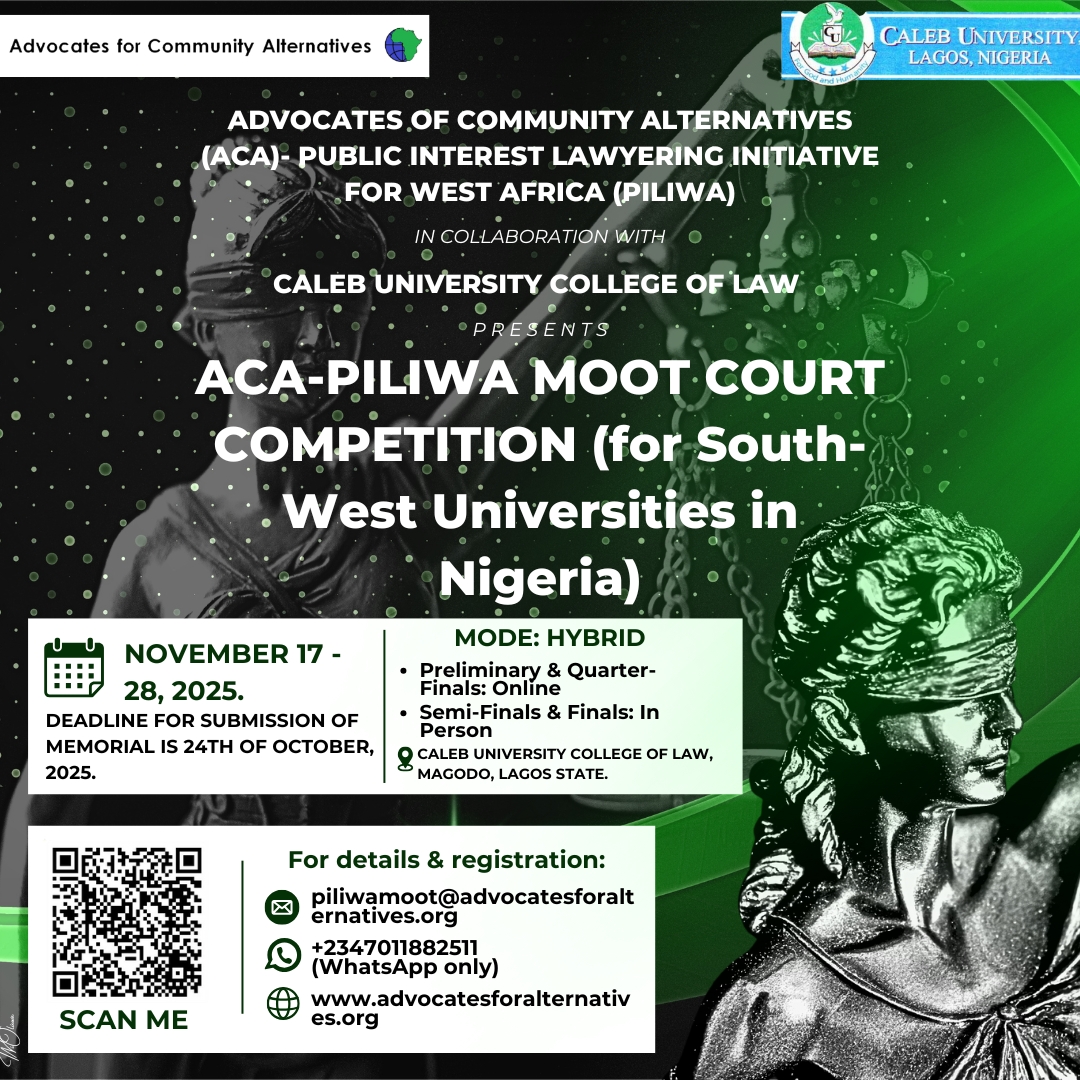
    Advocates for Community Alternatives (ACA), in partnership with the Public Interest Lawyering Initiative West Africa (PILIWA), is pleased to announce the inaugural edition of the ACA-PILIWA Moot Court Competition—open exclusively to law students from universities in South-West Nigeria.

    The competition will take place in a hybrid format from 17th to 28th November 2025. The preliminary and the quarter-final rounds will be held virtually while the semi-finals and the final rounds will take place in-person at the College of Law, Caleb University, Magodo City Campus, Lagos State, Nigeria.

    This landmark event aims to inspire the next generation of public interest lawyers by engaging undergraduate law students in critical issues surrounding human rights and environmental justice in Africa.

    Participants will explore the application of regional and international human rights instruments, strengthen their legal research and oral advocacy skills, and deepen their understanding of public interest litigation in contemporary legal and social contexts.

    Interested qualified applicants are to reach out to the organizers via this e-mail address for further information: piliwamoot@advocatesforalternatives.org

    About the Organizers

    Advocates for Community Alternatives (ACA)

    Founded in 2016 and incorporated in both the United States and Ghana, ACA is a non-profit organization dedicated to supporting West African communities threatened by harmful external development projects. ACA helps communities define and pursue their own vision for sustainable development and actively engages in grassroots activism. The organization also offers legal, technical, and moral support to public interest lawyers advocating human rights, environmental justice, and community land rights.

    Public Interest Lawyering Initiative West Africa (PILIWA)

    The Public Interest Lawyering Initiative for West Africa (PILIWA) is a regional movement of lawyers driven by social justice to serve threatened communities. ACA is the coordinating body for PILIWA, which aims to inspire and train a movement of lawyers that serve communities and assist them to fight for their own vision of the future in the face of pressure from powerful political and economic actors. PILIWA members include individuals and organizations on the front lines of the fight for justice and sustainable development in eight West African countries.

    Kindly visit https://advocatesforalternatives.org/ or follow us on our social media handles for updates and announcements:

  • Igbogidi community takes action to protect their water

    Igbogidi community takes action to protect their water

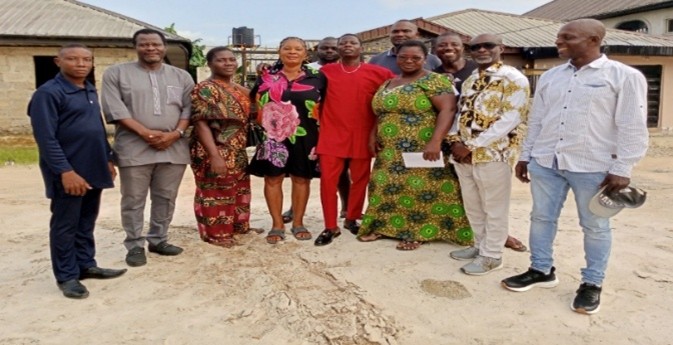
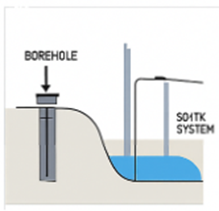
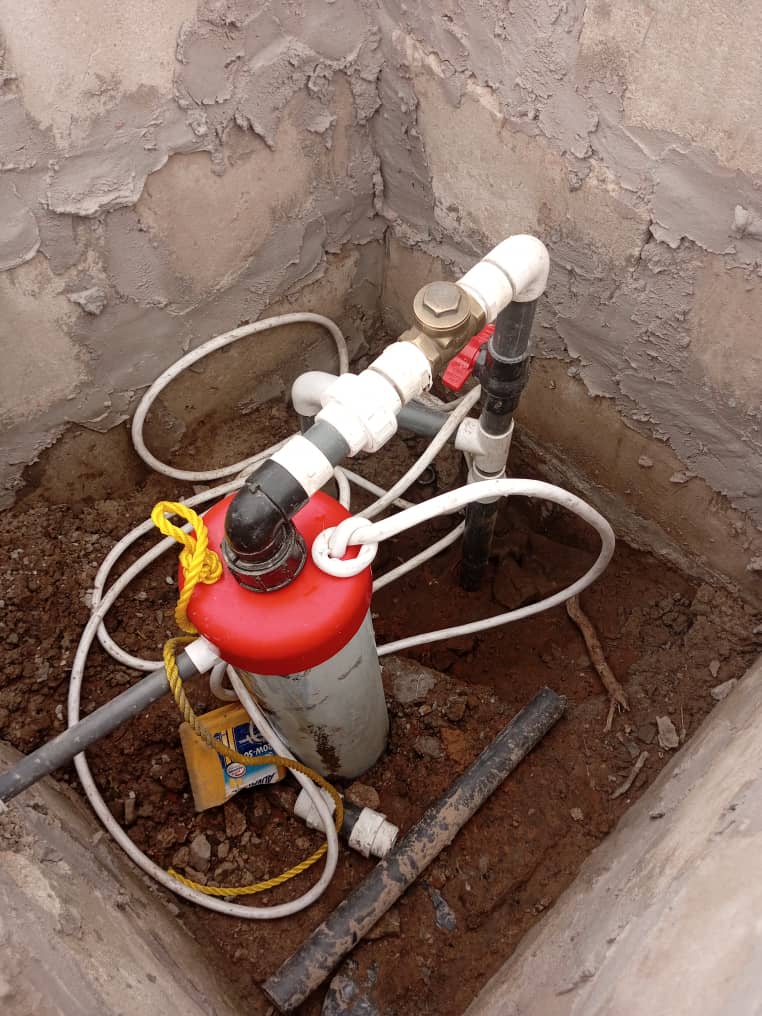
    When Paul Adjekota, a Science Fellow with Advocates for Community Alternatives (ACA), first visited Igbogidi in southern Nigeria, he noticed something alarming: boreholes drilled just a few feet from septic systems.

    Concerned about possible contamination, Paul shared his observation with local leaders. The community agreed — something had to be done.

    The Power of Participation

    Over a dozen community members — including farmers, traders, youth, and elderly people, stepped up to be part of the solution. Under the guidance of Professor Oghenero Asuma, a hydrogeologist from Delta State University, they began learning how to collect and test water samples themselves.

    “I don’t have much schooling,” one mother said during their first meeting, “but I know this is important for our children.”

    What the tests revealed

    Water samples from six sources — four boreholes and two wells — revealed some serious concerns:

    • pH levels ranged from 3.8 to 5.3, meaning the water was acidic and unsafe to drink.
    • Coliform bacteria (1–7 cfu/ml) were present in all samples, indicating contamination likely from nearby septic systems.
    • No heavy metals were found, offering some reassurance that there was no dangerous presence of lead, chromium, or nickel.

    From information to action

    Instead of creating fear, the test results sparked a wave of positive change:

    • Families have begun boiling their water or using chlorine drops to make it safer for drinking.
    • Some households have also started experimenting with periwinkle shells, a local resource, to help reduce acidity in their water.
    • The community made a firm decision to enforce safe distances and proper depth when siting in new boreholes.

    One youth leader shared, “If someone wants to drill a borehole tomorrow, I now know the right depth and distance to insist on.” Another added, “Before, I just fetched water. Now, I understand what makes water safe or dangerous.”

    Planning for the future

    Igbogidi isn’t stopping here. The community has committed to:

    • Repeat water testing every three years
    • Share their knowledge with neighboring villages
    • Monitor future water projects closely

    Already, nearby communities are starting to ask questions about their own water sources — a ripple effect of awareness and empowerment.

    A Model for West Africa

    Igbogidi’s experience is a powerful example of what can happen when science meets community action. In many parts of West Africa, poor borehole placement still threatens public health. But by combining expert guidance with local involvement, communities can take control — ensuring clean, safe water for generations to come.

  • Hope on the rise: Grassroots communities in Ghana build big dreams with small grants

    Hope on the rise: Grassroots communities in Ghana build big dreams with small grants

    In the heart of Ghana’s Bono East and Eastern Regions, something extraordinary is happening — not from the top down, but from the ground up.

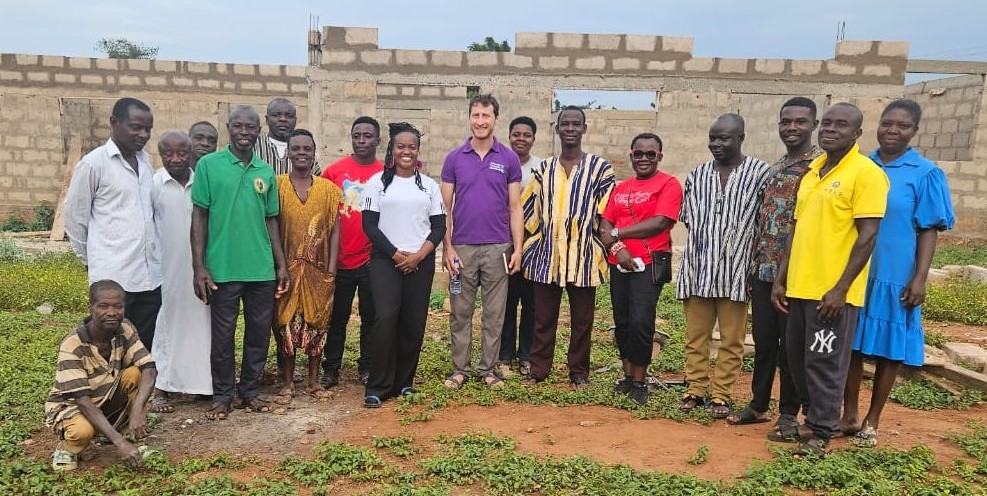
    Jonathan Kaufman, Executive Director of Advocates for Community Alternatives (ACA), recently toured five rural communities where residents are rolling up their sleeves and transforming their lives through a bold initiative known as the Facilitated Collective Action Process (FCAP), locally dubbed “Oman yie die.”

    With support from ACA and $8,000 in seed funding per community, places like Asuano, Johnkrom, and Nkwabeng in Nkoranza South, along with Ntabea and Abesim Yeboah in Abuakwa South, are turning microgrants into major milestones.

    In Asuano, construction is well underway on a new three-unit Junior High School block, complete with an ICT lab and teacher offices — a dream come true for students who previously studied under trees or in cramped conditions. In Johnkrom, women and youth are eagerly watching a new gari processing and milling center take shape — a move expected to boost local income and food security.

    But perhaps the most ambitious vision comes from Nkwabeng. Originally aiming for an outpatient department, the community is now rallying additional funds to build a 24-room health facility. Their goal is to upgrade their modest clinic into a fully functional polyclinic — a leap forward in rural healthcare.

    “These communities are not waiting for change — they’re building it,” said Mr. Kaufman. “And what’s even more inspiring is how openly and honestly, they’re doing it. I attended two accountability sessions where community leaders detailed every cedi spent. This kind of transparency sets a gold standard.”

    The ACA team, including Director of Community-Driven Development, Nana Ama Nketia-Quaidoo, also met with local government officials who are not just observing, but actively participating. Nkoranza South’s MCE, Godfred Dapaah, was praised for helping secure vital permits, including clearing hurdles with the Forestry Commission to allow timber harvesting for roofing.

    In Atiwa West, the spirit of partnership was equally strong. District Chief Executive, Amo Johnson Anom, personally donated building materials to a community project and even mediated a local conflict, urging unity for the greater good.

    “These leaders are not just sitting in offices — they’re getting their hands dirty for their people,” Mr. Kaufman added.

    Nana Ama noted that despite setbacks like seasonal storms and occasional leadership disputes, progress has been swift and spirited.

    “In just two months, most projects already have their roofs on. The communities have gone above and beyond — raising funds locally, contributing to labor, and staying resilient. That’s real ownership,” she said.

    From new classrooms to life-saving health facilities and income-generating centers, these projects are a testament to what happens when communities lead their own development — with a little support and a lot of heart.

  • Marginalized Affected Property Owners (MAPO) enjoins Koidu Ltd, Octea group of Companies

    Marginalized Affected Property Owners (MAPO) enjoins Koidu Ltd, Octea group of Companies

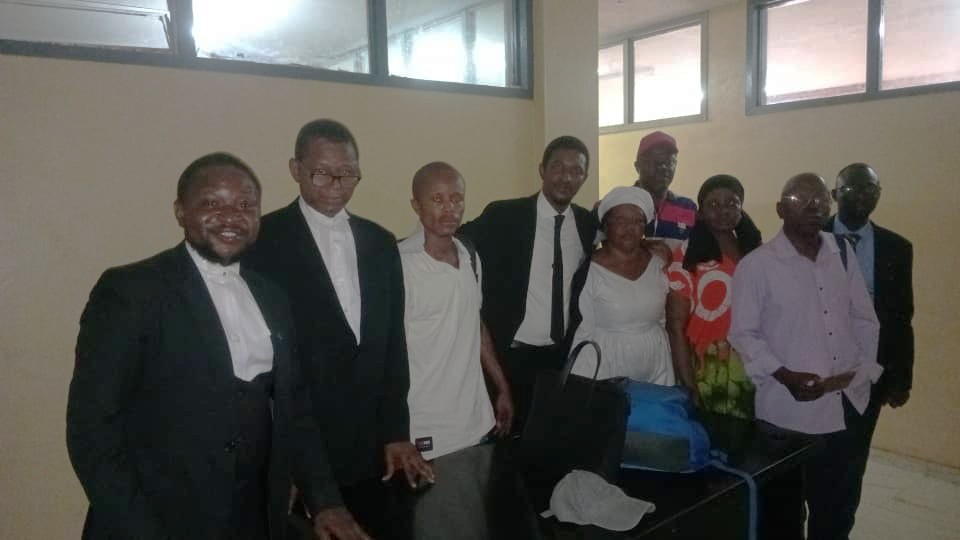
    The Sierra Leonean Court of Appeal today extended an interim injunction brought against the Koidu Limited Mining Company, a major mining company operating in Koidu City Tankoro Chiefdom, Kono District to next Monday July 28th, 2025. The injunction application, brought before the court by the Marginalized Affected Property Owners (MAPO) was first upheld last Thursday in Freetown.

    The court’s order prohibits the company (Koidu/Octéa mining company limited) from selling, disposing of or in any way alienating any of its properties.

    On Thursday 17th, July 2025, the court granted an interim injunction against Koidu Limited Mining Company, a major mining company operating in Koidu City Tankoro Chiefdom, Kono District.

    This legal action was initiated following a request made by the lawyering firm C&J Partners, working with the Network Movement for Justice and Development (NMJD), with support from the Advocates for Community Alternatives (ACA).

    The injunction is a temporary measure, pending further legal proceedings. The court has scheduled a hearing for Monday 21st, July 2025, where both the complainants and the defendants will present oral or electronic arguments, each side allocated 20 minutes to state their case.

    This case is expected to have broader implications for corporate accountability and community rights in Sierra Leone’s mining communities.

    At today’s hearing, the motion was converted to inter partes. Counsel for the company pleaded that due to the other injunctions pending against the company, he would like the court and the applicants to be served with those papers in the form of an affidavit in opposition.

    Counsel for the applicants are expected to file an affidavit in reply.

    Brief background

    Koidu Limited is a diamond mining company that operates in Sierra Leone and is privately owned by BSG Resources Limited (BSGR) through its subsidiary, Octéa Limited. The company is accused of degrading the living conditions of people living near its mining operations and failing to properly relocate them or compensate them for their losses.

    Residents who have not been relocated find it increasingly difficult to farm because waste rock and rubble from Koidu Ltd.’s operations have covered much of their farmland. “Koidu Limited has destroyed our lives,” said Mr. Prince Boima, Chairman of the Marginalized Affected Property Owners Association. “We used to farm and live in peace, but now our lands and water sources are poisoned and covered in rubble. Our homes are shaken by explosives every day.”

    Residents also report that their health has suffered. Dust from the mining operations often cover the community and causes headaches, difficulty breathing, and a burning sensation in the residents’ eyes. The operations have also contaminated the water, and many residents develop skin rashes and digestive problems they did not previously experience. High stress from living with frequent blasting further causes headaches, high blood pressure, heart palpitations, and respiratory problems in the community.

    Despite promising to properly relocate affected community members in advance of expanding its mining operations, Koidu Ltd. has left the people to suffer.  Many community members have neither been relocated, nor compensated for the damage to their properties, health, and livelihoods.  Others have been relocated to a new area, but the conditions of relocation have been incommensurate with what they lost.

    In all these, Koidu Limited had closed the mine, laid off all its workers, and was stripping valuable machinery from the site. The mine site is currently stripped of everything of value except for the power plant and is abandoned except for a token detachment of police officers who are keeping guard. This prompted the plaintiffs to freeze the company’s assets to ensure that there would be enough left to satisfy an eventual judgment in favor of their favour.

    The community is supported in its fight for justice by Advocates for Community Alternatives (ACA), a Ghana-based human rights organization, and Network Movement for Justice and Development (NMJD), a Sierra Leonean civil society organization that organizes communities for a more just society in the face of natural resource extraction.

  • Eric Anorrey named the Most Outstanding Sora Kaufman Fellow for 2025

    Eric Anorrey named the Most Outstanding Sora Kaufman Fellow for 2025

    In the heart of Ghana’s Bono Region, a quiet revolution is taking place. It’s not led by politicians or corporations, but by a determined young change-maker named Eric Anorrey who has been named as the Most Outstanding Sora Kaufman Fellow 2025. His recognition is not merely a personal accolade—it is a resounding endorsement of a vision that centers communities as architects of their own development.

    The Sora Kaufman Fellowship is an Advocates for Community Alternatives’ flagship program to establish a network of African leaders and practitioners in the field of community-driven development and advocacy. This exchange program targets practitioners who collaborate with relevant stakeholders to tackle community and systemic challenges that hinder the accessibility and involvement of citizens in decision-making.

    For emerging as the Most Outstanding Sora Kaufman Fellow 2025, Mr. Anorrey is receiving a $10,000 grant from the Fellowship to embark on a community-driven initiative designed to improve the economic wellbeing of 20 vulnerable women in the Sunyani Municipality, including teenage mothers and unemployed women below 45 years in the informal sector in Sunyani Zongo. Ultimately, this project aims to improve the socioeconomic status of these 20 women in the informal sector by providing them with guidance and mentorship as they pursue various economic ventures of their choices to achieve sustainable livelihoods and financial independence.

    Success indicators

    By July 2026, Mr. Anorrey hopes to ensure that the economic wellbeing of some 20 unemployed teenage mothers and single mothers under 45 years in Sunyani Zongo are improved and are financially independent through this intervention. Mr. Anorrey’s project further hopes to develop a strategic partnership between the 20 unemployed women and the Sunyani Municipal Assembly to ensure that the assembly incorporates marginalized women’s needs into its medium to long-term plans by July 2026.

    About GYIC

    Mr. Anorrey is the Executive Director of the Global Youth Innovation Center (GYIC) LBG, which was founded in May 2019. GYIC is legally registered in Ghana as a non-profit organization. The organisation envisages a world free of discrimination and inequalities in which all people are treated fairly and not discriminated against because of their race, gender, mental or physical disability.

    Gratitude

    Mr. Anorrey’s selection as the Most Outstanding Fellow is not just a mark of distinction, it reflects how he has embodied the values of the Fellowship. His gratitude message captured it best: “Being named the Most Outstanding Fellow is both humbling and inspiring. I see it as a responsibility to do more, give more, and lead with integrity and empathy. My selection is a celebration of the collective effort of everyone who believes in grassroots-led change. Together, we are shaping a future where communities are not just beneficiaries, but architects of their own development”, he said.

  • IFC Plays Pontius Pilate, Dodges Accountability for Harmful Rubber Project in Liberia after Six Years

    IFC Plays Pontius Pilate, Dodges Accountability for Harmful Rubber Project in Liberia after Six Years

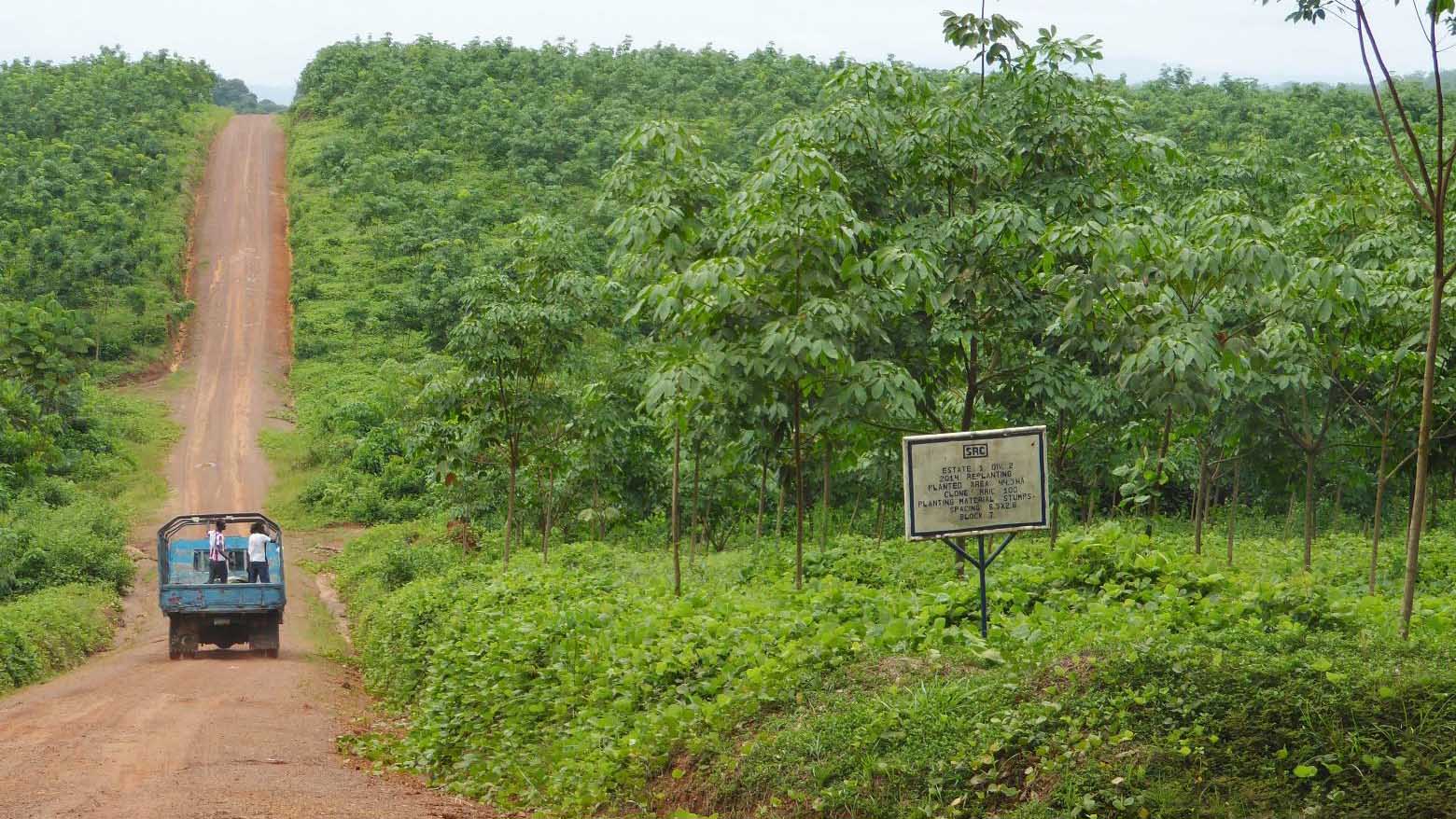
    In 2019, 22 communities in Liberia filed a complaint with the World Bank Group’s Compliance Advisor Ombudsman (CAO), accusing the International Finance Corporation (IFC) of fueling abuse and environmental destruction through a loan to the Salala Rubber Corporation (SRC). That loan helped SRC expand its rubber plantations—with devastating consequences.

    Nearly six years on, in March 2025, the CAO published its damning findings: the IFC failed to follow its own safeguards, enabling widespread harm to land rights, community health, and cultural heritage. Women suffered, with disturbing reports of sexual exploitation by SRC contractors who demanded sex in exchange for jobs or wages.

    But rather than take full responsibility, IFC Management responded with a weak action plan that – aside from a livelihoods fund that should provide some welcome livelihoods support to the impoverished populations of plantation-adjacent communities – leans on voluntary reforms by SRC’s former owner, Socfin, and its new buyer, Jeety.  Civil society groups say this move amounts to passing the buck.

    “The CAO has validated the long-standing concerns expressed by local communities: that the International Finance Corporation (IFC) not only overlooked critical issues but also allowed its client to illegally seize land, contaminate vital water sources, and perpetuate various forms of violence and abuse,” stated Alfred Lahai Gabbai Brownell Sr., a lawyer representing the 22 affected communities and the winner of the 2019 Goldman Prize for Africa. “Now, the IFC is playing Pontius Pilate, washing its hands, asserting that it is powerless to take any corrective measures merely because the loan has been repaid. This is not a demonstration of accountability; rather, it constitutes a profound abandonment of responsibility towards those impacted.”

    The communities’ complaint details how SRC’s expansion left entire villages landless, razed crops without compensation, and disregarded ancestral land claims. Toxic chemicals leached into waterways. Women faced systemic sexual violence. And throughout, IFC continued to finance the project, despite knowing SRC lacked the capacity—or will—to protect people or the environment.

    The CAO agreed with almost all of the communities’ claims and urged IFC to commit to real remediation. But because the CAO can only make recommendations, it’s up to IFC Management to act—and so far, its response falls short.

    Key concerns with IFC’s response include:

    No accountability for land rights violations: IFC refuses to examine whether the plantation was built on land the government had no right to give away.

    No proper analysis of Indigenous identity: IFC sidestepped the question of whether the affected Kpelle communities are Indigenous, citing generalizations rather than facts on the ground despite an abundance of expert testimonies and very strong recommendations from the CAO.

    A shameful and diluted compensation plan: IFC proposes to create a livelihood fund that is spread across all surrounding communities—not just the 22 complainant villages—potentially weakening the communities’ support network and failing to address specific harms.

    Shrugging off responsibility: IFC claims it has no leverage since the loan was repaid and the plantation was sold. But the CAO clearly states IFC could have, and still might, use legal remedies to demand accountability from SRC.

    Delaying action: Claiming that the security situation in the communities is too unpredictable, IFC management has declared that the implementation of its assistance plan will be delayed until an undetermined date in the future.

    While we welcome the CAO’s clear and courageous findings—and hope the livelihoods fund offers some relief—we reject IFC’s decision to wash its hands, and walk away from the communities it helped harm. The burden of fixing this mess should not rest on the goodwill of private plantation owners. IFC must step up, accept responsibility, and ensure the communities finally get justice.

    The Affected Indigenous Communities are shocked and overwhelmed by their frustration and condemnation of the IFC and those voices are captured in this press statement as follows:

    Ma. Mattia Gbar, Chairlady, Martin Village: “We depend on our land and forest for everything, fishing, making farm, medicine for treatment when we are sick, and other activities, but since SRC took our land, everything is hard for us. So, why will they say we are not traditional people? Let them pay for everything they did to us.”

    Yeagbamah National Congress for Human Rights, a victim of SGBV, name withheld for her protection: “I and other women were asked for sex just to get or keep a job with the company. This is not just unfair—it is violence. It can hurt women and keep them afraid and silent. The IFC’s action plan talks about protecting people and fixing harm, but what about the women who suffered this violence and abuse? We want to see real action, not just promises. The IFC and the company must make sure this never happens again and that we women get justice. Respect for women must be part of the solution, said, SGBV victim from SRC.”

    Mr. James Gorgbor, Elder, Gorgbor Town: “Look, I have always said that IFC supported SRC to kill us on our own land. I worked for SRC for so many years until I fell sick, and the management left me on sick bed and paid me off without any benefit.  They took 95% of my land and destroyed all of the rubber I planned for my children. Their Management Action Plan is beating around the bush. What I can say is, let them pay for our crops according to the COA Compliance Report, because we don’t know who will implement the Management Action Plan.”

    David Shiffa, Elder, Shiffa Molley Villiage: Let IFC pay for all the harms. One thing I can say is we are traditional people and if IFC do not believe that, I think they should bring someone to check on the way we are living. We have lived here for so long practicing our culture, and we believe in our tradition.”

    Ma. Quetta George, Chairlady, Doakai Town: “The thing SRC did to us with this IFC money is not good. The company took the money and came on our land and cut our rubber down and planned their rubber. Today some of our rubber is among their rubbers and they’re tapping it. They did not pay for our rubbers, and they also destroyed our town. The CAO report says they must pay for it, they made a plan for the report, and who will work with the plan, because SRC is going, and Jeety says he bought the plantation.” So, let IFC pay for all our things the company spoiled and give our land back.”

    Pastor. Melton Gweh, Elder, Gleebah Town: “IFC told us that, since 2020 they have no contract with SRC, and the COA report says that IFC should work with SRC to address our complaint. IFC has come up with a Management Action Plan, who will implement the plan since SRC is going? We are calling on the IFC to be the ones to implement the plan in line with CAO recommendations.t”

    Equally disturbed and deeply betrayed by the IFC’s inadequate actions are also the leadership of the supporting organizations that tried to work with the IFC to resolve the violent abuses perpetrated by the IFC client. Those voices are also captured below:

    Francis Colee, Head of Program and Acting Director at Green Advocates International “While we can thank the IFC management for some of the actions they have taken to assist the victims in the Management Action Plan (MAP), it is disappointing that the IFC greatly undermined the victims’ ability to receive real benefits for the harm they suffered because of the IFC’s failure to effectively apply its own definition of Indigenous peoples, as clearly and succinctly provided in the IFC Performance Standards. This makes the IFC complicit in the harm these people suffered.”, Francis Colee, Head of Program and Acting Director at Green Advocates International

    Paul Larry George, Chairman, of Alliance for Rural Democracy (ARD): “I welcome the recommendations and findings of the CAO report and believe that the recommendations and findings are evidence of the voices and struggles of affected communities, who have long demanded justice for the harm caused by the IFC’s financing of SRC’s operations. I am deeply troubled that, despite overwhelming evidence of abuse, SRC has chosen to neglect responsibility for the damages caused by allegedly divesting the company to an Indian businessman Jetty, whom we believe will not uphold or take full accountability for implementing the IFC so-called MAP”.

    Windor B.K. Smith, Head of Secretariat, Alliance for Rural Democracy (ARD), “I believe that, IFC is hiding under the escape tactic of SRC to neglect its responsibility to the affected communities. I am calling on the IFC and its client, SRC, to take full responsibility for the harm caused to the lives of Indigenous communities and fully respond to the concrete recommendations and findings in the CAO report. True accountability requires more than a repaid loan that IFC speaks of. It requires compensation, recognition of Indigenous rights, and a clear plan for remediation. The ARD is very disappointed with the IFC MAP and is calling on the IFC to honor the CAO’s recommendations, work directly with the impacted communities, and ensure that justice is not delayed or denied.”

    Abraham N. Kamara, Chairman, Yeabamah National Congress for Human Rights (YNCHR): “I am calling on the IFC to take full responsibility of the harm done to us as Indigenous Communities. The Management Action Plan released by the IFC, does not address the complete recommendations proposed by the CAO, and we think this is unfair to us, because I have advocated for so long that I am now disabled from the blindness I suffered when the state and SRC security forces arrested me and sprayed a tear gas canister directly into my eyes.”

    Veronica B. Gray, Acting Head of Secretariat, Natural Resources Women Platform (NRWP), “The CAO report confirms what women in affected communities have been saying for years—we have lost land, our environment is damaged, and women have faced threats, harassment, and sexual and gender-based violence (SGBV) without protection or justice. These are not isolated incidents; they are the result of intentional, willful, reckless, and systemic negligence. The IFC cannot hide behind SRC’s divestment. Real accountability means compensation, recognition of rights, and direct action to repair harms. Anything less is injustice. We believe that justice that is delayed or diluted is, in effect, justice denied. The lives, dignity, and lands of Liberian communities must not be collateral damage for profit”,


    Contact information for Media Inquiries

    Jonathan Kaufman (Advocates for Community Alternatives): +1 617 645 4069, jonathan@advocatesforalternatives.org

    Francis Colee (Green Advocates International): +231-777-770-206, francis.colee@greenadvocates.org

    Paul Larry George (Alliance for Rural Democracy): +231-777-216-981, chairman.ard@gmail.com

    Windor B Smith (Alliance for Rural Democracy): +231-886-726-037, ard.headsecretariat@gmail.com

    Veronica Gray (Natural Resources Women’s Platform): +231-888-312-250, nrwomenplatform@gmail.com

    Abraham Kamara (Yeabamah National Congress for Human Rights: +231-775-071-272

    Ma. Quetta George (Doakai Town): +231-881-758-466

    Pastor. Melton Gweh (Gleebah Town): +231-886-933-720

    Mr. James Gorgbor (Gorgbor Town): +231-886-111-928
  • Bonsu community improves access to water through Oman yie die

    Bonsu community improves access to water through Oman yie die

    Access to clean water is no longer a distant dream but a growing reality at Bonsu, a farming community in the Nkoranza South Municipality of the Bono East region, thanks to a community-led initiative through the Facilitated Collective Action Process (FCAP).

    For years, residents of Bonsu, especially those living in the newly developed areas, have had to commute long distances in search of water from either a nearby stream or from a few individuals with mechanized boreholes in their homes daily. These residents, especially women and children would typically load a bicycle with jerrycans, push them for long distances, thereby negatively impacting their health.

    To address this challenge, the people of Bonsu began working collectively to extend pipe-borne water directly to various homes in October 2024.

    This bold step toward improving public health and daily living conditions was made possible with a GHS 120,000.00 microgrant from Advocates for Community Alternatives (ACA).

    So far, the impact has been quite remarkable as 75 out of about 307 households have been connected to the water system while most of the remaining households are in the process of getting connected. The community envisages at least 87 households, representing 40% of the households would have access to pipe-borne water in one year’s time.

    This is expected to significantly reduce the burden of walking long distances for water and ensuring a safer, more convenient water supply.

    Sustainability

    Beyond improving access to water, the project is also strengthening the community’s financial sustainability.

    Any household that seeks to extend the water, contributes a token of GHS 200.00 to the Oman yie die Committee, creating a local fund that will be used to support other development priorities identified during the community’s visioning and goal-setting stage of the FCAP process.

    Sharing his enthusiasm about the project’s long-term impact, Mr. Ameyaw Franklin, Technical Advisor from the Nkoranza South Municipal Assembly, said: “I’m excited about the fact that water will not be wasted but rather stored and used efficiently to benefit residents. Even more importantly, the small contributions from households will help generate income that the community can reinvest in future development initiatives.”

    Ms. Juliet Fosuaa, the Community-Based Facilitator, also reflected on the journey with pride saying: “I’m really excited about the knowledge ACA equipped me with through the FCAP methodology. It gave me the skills to guide my community in developing a shared vision, and today, that vision is becoming a reality through this successful water extension project.”

    Community-led

    The Bonsu water extension project stands as a compelling example of community-led development in action, where local voices, local leadership, and shared responsibility come together to create lasting change.

    Advocates for Community Alternatives, an NGO operating in Ghana using the FCAP methodology, is extremely excited to watch communities own their development trajectory, hoping that government and other social actors will be interested in adopting this strategy towards community planning and development.

  • Eric Anorrey extols SK Fellowship’s positive influence on him

    Eric Anorrey extols SK Fellowship’s positive influence on him

    “The Sora Kaufman Fellowship has set a solid foundation for my leadership in the civil society space, enhancing my adaptability and teamwork, and strategic thinking in leading Global Youth Innovation Center (GYIC) for community impact”, Eric Anorrey, a proud member of the Sora Kaufman Fellowship.

    The 37-year-old Project Manager for the Livelihood and Environment Ghana (LEG) describes his experience with the SK Fellowship as “immersive, focusing on key areas vital for driving social impact.” 

    Mr. Anorrey, who currently leads the STAR Ghana Volunteerism Project in Atebubu in the Bono East Region has been throwing some light about his encounter with SK Fellowship as captured below.

    My name is Eric Anorrey, a Ghanaian with a Bachelor of Arts in Development Education from the University for Development Studies in 2014. I work towards a just society where resources and opportunities are distributed fairly while the populace are recognized as the key actors in their own development rather than passive recipients of commodities and services. My community work has been guided by empathy and compassion, accountability, integrity and transparency, respect for diversity and inclusion, cultural sensitivity and self-reflection and continuous learning. I have a particular interest in youth development that fosters skilled youth population and empowers vulnerable women for decent employment and improved livelihoods that protects their human rights and dignity, as well as rural development and environmental management and sustainability.

    My one-month intensive training with the Sora Kaufman Fellowship provided an invaluable experience in shaping my leadership and professional development skills, as well as a period of transformation and enrichment for me and my community work.

    I have enjoyed the knowledge from renowned experts in leadership, governance and other topics like networking, advocacy, and grant writing which have provided me with tools and insights to lead more effectively, develop collaborative relationships, and sustainably develop professionally and impact more communities through my work. I found the balance between theoretical knowledge and practical application to be very impactful.

    Furthermore, the peer networking established during my one-month stay has proven to be a valuable resource for future collaboration and growth. The opportunity to learn and share experiences with colleagues from different regions and organizations has proven to be very valuable, and fostered a collaborative learning atmosphere, giving me different perspectives to confront real-world challenges that create change in communities.

    My encounter with the residents of Addo Nkwanta during our two-day community stay was outstanding. This influenced my perspective on community-driven development efforts and valuable feedback from the residents.

    Fellows will always remember our field trips with the Advocates for Community

    Alternatives’ team, as well as the good times that came with them.  From reception to departure, we had amazing experiences together, creating an inclusive and diverse environment for all fellows.

    Our dinner night was a mix of happy and sorrowful moments as fellows said goodbye to one another and waved at their final residential night.

    The Sora Kaufman Fellowship has set a solid foundation for my leadership in the civil society space, enhancing my adaptability and teamwork, and strategic thinking in leading Global Youth Innovation Center (GYIC) for community impact. The sessions focused on adaptable leadership, and effectively managing diverse teams. Practical case studies reinforced my abilities for dealing with real-world organizational challenges.

  • Enrolment significantly increases following renovation works on Saamang R/C school

    Enrolment significantly increases following renovation works on Saamang R/C school

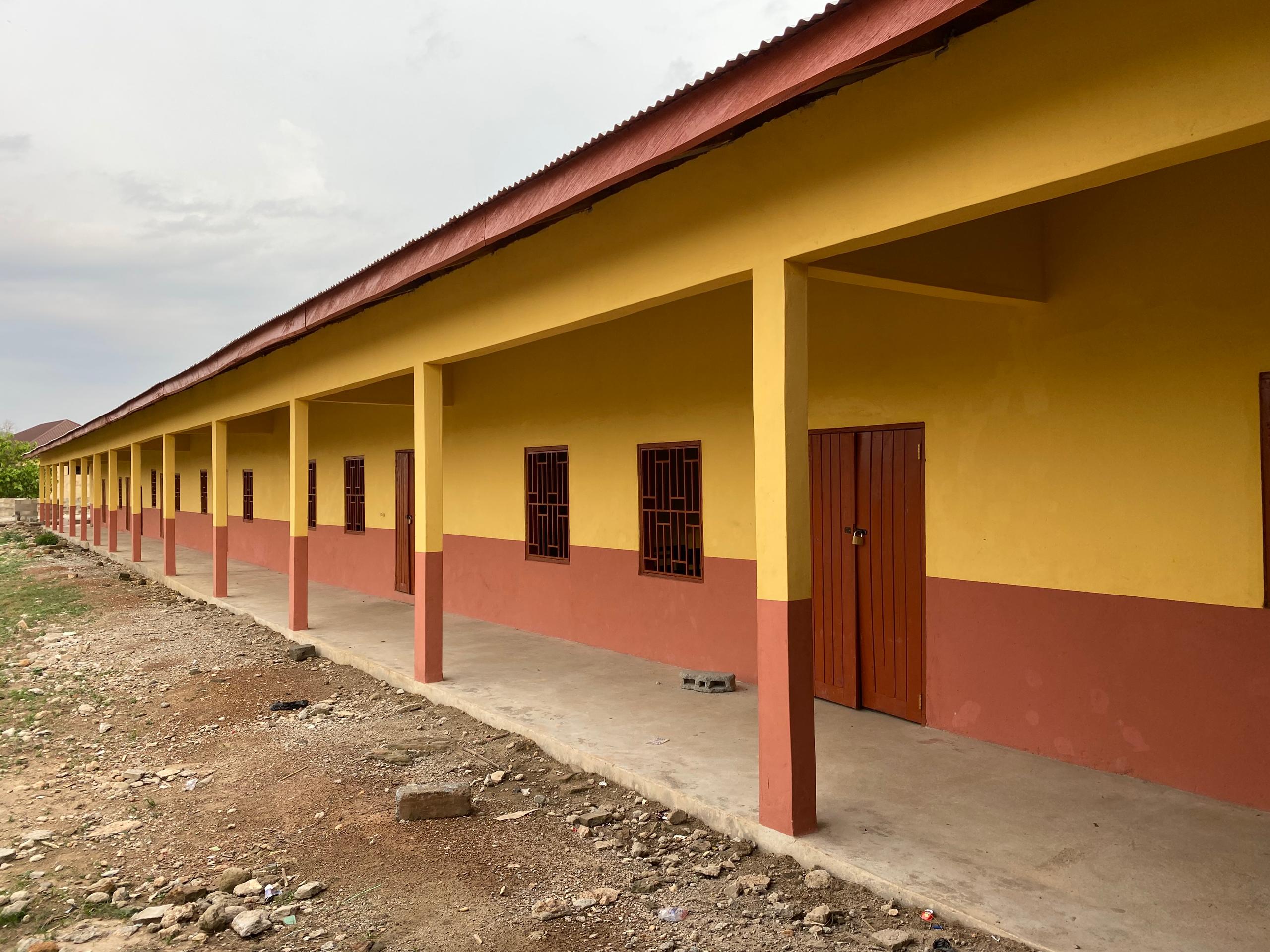
    The Saamang local Roman Catholic Basic School in the Fanteakwa South District of the Eastern region of Ghana this year enrolled 85 new pupils, pushing its total enrolment figure from 150 to 235 and making it the second largest primary school in the area.

    This significant increase of 56.6% of student population follows the completion of renovation works on the school last year.

    Pupils and teachers of the kindergarten and the primary sections could not hide their joy when they were ushered into their newly renovated classroom block at the beginning of the academic year.

    The headmaster of the school, Mr. Samuel Abrokwa, said in an interview that the facelift given to the school has undoubtedly impacted positively on the academic fortunes of the school and commended the Fanteakwa South District Assembly and ACA for coming to their aid.

    “We are so happy to be learning under such a conducive environment and this would undoubtedly enhance teaching and learning in the school”, one of the pupils said after her first day in the renovated building.

    Renovation works on the school were carried out last year under the Facilitated Collective Action Process (FCAP), a partnership between the district assembly and Advocates for Community Alternatives (ACA), a non-governmental organization, which helps West African communities that are threatened by the destructive impacts of extractive projects to take control of their futures.

    Following the completion of the project, the school is now providing convenient teaching and learning environment for the kindergarten and the primary sections of the school and ultimately contribute to the overall improvement in educational standards in the district.

    /By the end of this academic year, the dropout rate is to decline by 5%. It is also anticipated that the completion of this project will, in the long-term, reduce the cost of education for pupils in Saamang by 15%.

    In an interview, the Assembly member for the Saamang Electoral Area, Desmond Ofori Abrokwa, said the state of the school block prior to the start of the renovation works was deplorable and adversely affected enrolment as well as effective teaching and learning.

    “As I speak to you, our kids have a conducive environment to go about their studies. Also, teachers are happy to give their best. The looks on their faces tell it all”, he said.

  • Community-Based Facilitators undergo training on FCAP implementation process

    Community-Based Facilitators undergo training on FCAP implementation process

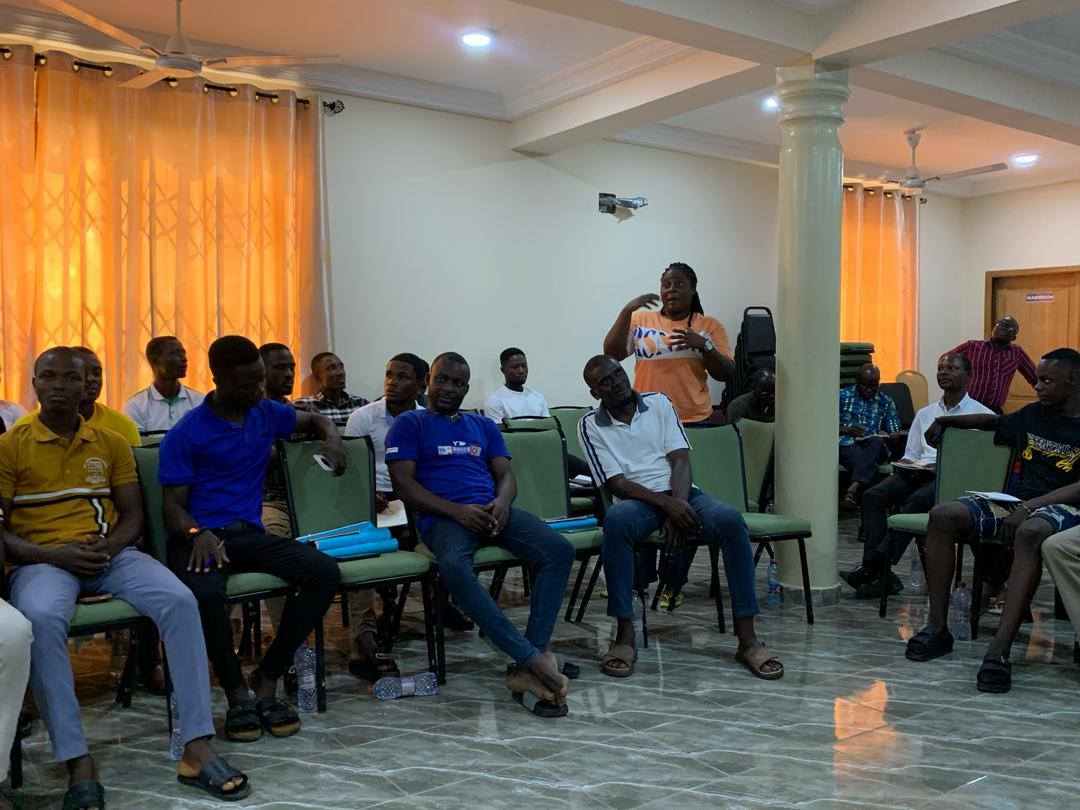
    Community-Based Facilitators (CBFs) from 45 communities and selected local government staff in Abuakwa South, Fanteakwa South, Atiwa West, and Nkoranza South have rounded up a week-long training programme on the Facilitated Community Action Process (FCAP), a community-driven development tool.

    Advocates for Community Alternatives (ACA), a non-governmental organization operating in Ghana and other African countries, organized the training to equip participants with the requisite skills in procurement methods, implementation action planning and budgeting, risk and mitigation strategies, and community engagement plans.

    These areas are crucial in ensuring transparency, efficiency, and sustainability in local development initiatives.

    Through interactive sessions and practical exercises, participants gained valuable insights into effective community engagements, project risk management, and accountable implementation strategies. The training also fostered collaboration between local government staff and community facilitators, strengthening participatory governance at the grassroots level.

    Following the planning process of the FCAP methodology, each community will receive $8,000 to support the implementation of their community-led development initiatives. This financial support will be complemented by community contributions, either in cash or in kind, ensuring shared ownership and sustainability of the projects.

    Communities will use these resources to develop action plans for projects such as CHPS compounds, teachers’ quarters, classroom blocks, boreholes, grinding mills, gari processing centers and bridges, among other community-driven projects.

    To enhance the success of these projects, communities will also benefit from technical advice from experienced professionals with expertise in their respective areas of development. This mentorship will help ensure the effective execution and long-term impact of their initiatives.

    Project execution and completion are expected within six months after community microgrant agreements are signed with the 45 participating communities. This timeline ensures that the development initiatives are implemented efficiently and that communities can quickly benefit from the improved infrastructure and services.

    Speaking at the training, Nana Ama Nketia-Quaidoo, ACA’s Director of Community-Driven Development (CDD) Department, emphasized the importance of inclusive planning and local leadership in ensuring development interventions aligning with community needs.

    “ACA remains dedicated to empowering local actors to champion development, accountability, and citizen participation. This initiative is expected to strengthen collaboration between communities and local government authorities, ultimately leading to more inclusive and impactful governance”, she also said.

    Participants expressed their commitment to applying the knowledge gained to drive meaningful changes in their respective districts.

    Credit: So Aba Boateng, Nkoranza