Category: Ghana

  • CiCoNet sharpens its advocacy skills on Ghana’s mining laws

    CiCoNet sharpens its advocacy skills on Ghana’s mining laws

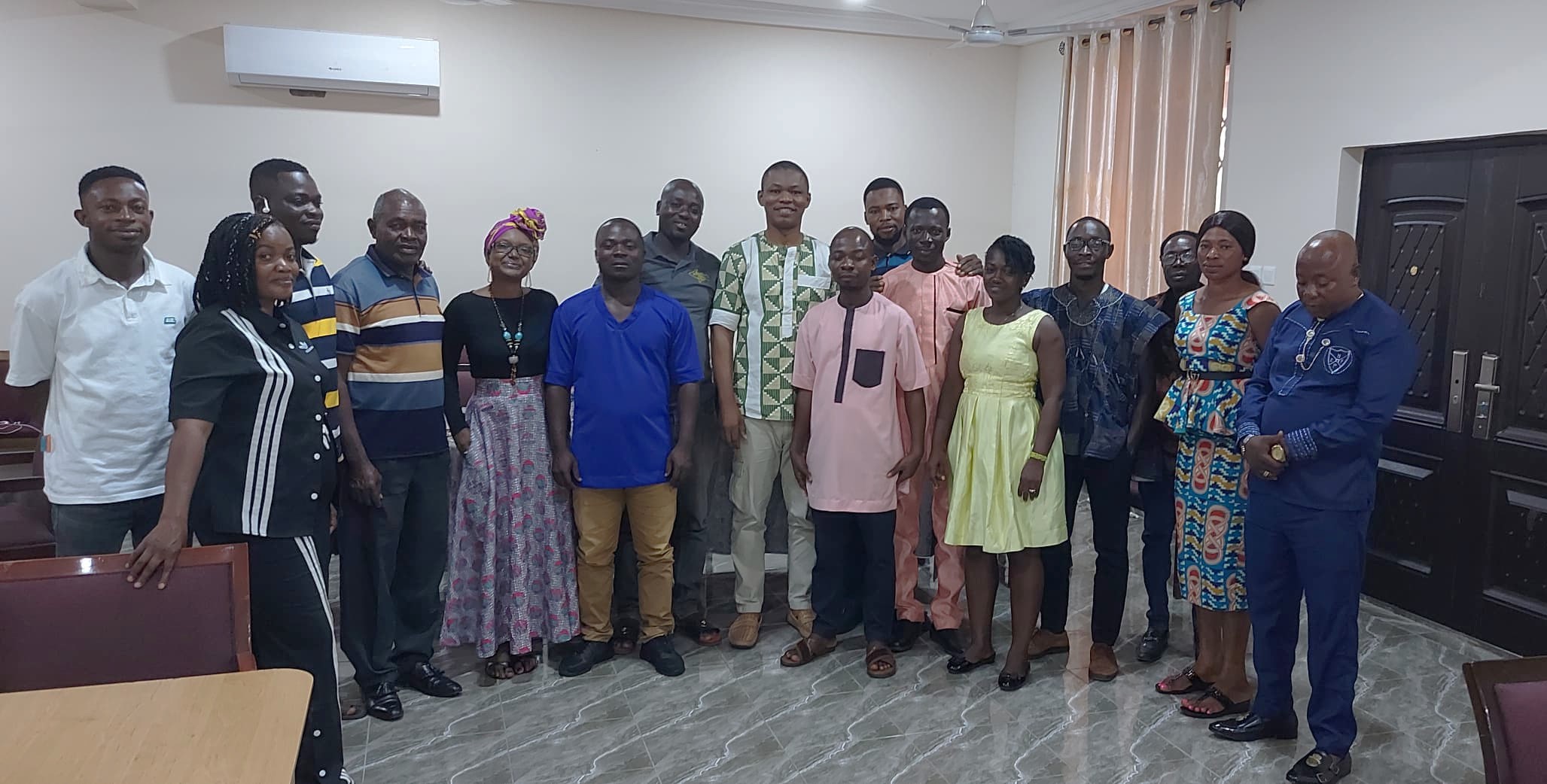
    A three-day training for national executives of the Citizens Committee Network (CiCoNet) is underway in Asiakwa in the Abuakwa South Municipality to keep CiCoNet members abreast of Ghana’s Minerals and Mining Act (Act 703 as amended).

    The training, referred to as Legal Learning Workshop, is being organised upon the request of the of CiCoNet to sharpen the group’s advocacy skills on laws about mining, land and general understanding of Ghana’s constitution.

    Advocates for Community Alternatives (ACA), a non-profit-making organization, which helps West African communities that are threatened by the destructive impacts of extractive projects to take control of their futures, is facilitating this training through its Legal Office and the Community-Driven Development Department.

    This is to enable CiCoNet to embark on its planned nationwide advocacy on the fundamental human rights of mining communities, among others.

    ACA’s Legal Team led by Lalla Toure welcomed the participants to the workshop and expressed the hope that they would be in the right position to embark on their planned advocacy on land and mining related issues at the end of their training.

    The team said all mineral resources are vested in the government in trust of the citizenry, adding that every land has an owner whose rights cannot be infringed upon by anyone and explained the differences between customary law and common law to the participants.

    The ACA Legal Team took the participants through various processes involved in land acquisition for mining or other purposes by the state.

    Some topics being covered during the three-day training program, which will end tomorrow Friday May 17, 2024, include land leasing process, compensation, land reclamation as well as land rent and land sale.

    “This training is very timely and I believe strongly that at the end of the training, participants will properly understand what the law says about the processes involved in the acquisition of land for mining activities and the role of each party in the acquisition of land for mining activities (land renters, land owners, chiefs and mining companies)”, Nana Ama Nketia-Quaidoo, the Director for Community-Driven Development, said in on the sidelines of the workshop.

    She was also hopeful that they will have a better appreciation of what the law says about the conversion of waste land created by the mining companies into land suitable for use of habitation or cultivation.

    About CiCoNet

    The Citizens’ Committee Network (CiCoNet) is an interface group of concerned citizens who help protect their communities’ development vision.  CiCoNet members are trained to speak with government officials and other stakeholders on behalf of their communities, raising concerns in ways that allow local authorities to help resolve key community concerns.

    Through CiCoNet, our communities have won key victories, such as prompting the suspension of a highly polluting mining company’s operating permit and inducing companies to fill abandoned pits that endangered the welfare of children and livestock.
  • Press Release – ACA Partners Ghana Government to Accelerate Development in 100 Communities

    Advocates for Community Alternatives (ACA) has launched a massive expansion of its community-driven development (CDD) work to one hundred communities in Ghana.  The project will put communities threatened by extractive development in control of their own development and give them the tools to advocate for their own vision of the future.

    ACA’s community-driven development programs revolve around two key elements.  The first element, the Facilitated Collective Action Process (FCAP), is a process that was developed and popularized in East Africa by ACA’s partner organization, Spark MicroGrants.  FCAP is a two-year program that encourages communities to create a common development vision and equips them with skills and financial resources – including a USD 9,000 microgrant – to pursue it.


    Read More….

  • ACA rewards community members

    ACA rewards community members

    In recognition of their exemplary roles in championing development in their communities and also serving as role models to others, four individuals have been awarded by the Advocates for Community Alternatives (ACA) as part the maiden annual national delegates’ conference of the Citizens Committee Network (CiCoNet), which took place at Osino in Fanteakwa South District of the Eastern Region.

    George Asante of Juaso emerged as the Over-all Best Community Member as a result of his dedication, tolerance and consistency in mobilizing support for Juaso community members, especially with regards to FCAP meetings.

    Although he is from Juaso, Mr. Asante has been extending his support to other FCAP communities such as Nsuapemso and Segyimase, especially when those communities are confronted with challenges.

    He offers the necessary assistance without asking for any honorarium in return.

    As an FCAP Chairperson, he has worked hard to increase attendance and participation of women in meetings and more importantly during decision-making in his community.

    Another resident of Juaso, Lydia Opokuaa, received the Most Inspiring Community Member award. She is a self-motivated female whose phenomenal interest and contributions in decision-making in her community cannot be over-emphasized.

    Madam Opokuaa Lydia fully attends FCAP meetings every week and participates in all activities for the development of her community.

    In her view, activities of the FCAP and CICONET are both geared towards her own community development. She also considers ACA’s methodologies to be non-discriminatory, giving everyone the opportunity to speak.

    According to her, the FCAP methodology has helped her to believe that disability is not inability. Madam Lydia has a stammer – a speech impediment that could otherwise discourage her from participating – but the FCA encourages her to get involved in decision making and contribute to the success of her community’s development in the long-term. She therefore entreats other community members with similar speech difficulties to learn from her and be encouraged as well.

    Emmanuel Antwi of Nwoase community in Nkoranza South Municipality of the Bono East Region and Rose Addo of Nsuapemso community in the Eastern Region were also recognized as the Most Dependable Community Members.

    Hon. Edward Kuyiweh of Salamkrom won the Most Disciplined Community Member award, while the Over-all Best Community award went to Segyimase. Records show that Segyimase community has the full participation of its chief in all FCAP meetings, with members being punctual and well-organized.

    All the award winners received Certificates of Recognition.

  • ACA partner communities embrace brafie “come home” initiative to promote community-driven development and resilience

    For the past five years, ACA has been working with communities in Ghana’s Bono East and Eastern Regions to help them realize their own development vision while avoiding the economic and social ills associated with unsustainable mining practices.  While ACA’s projects usually center around a micro-grant to each community and the community’s efforts to marshal its own resources, a number of the partner communities have now been turning to a new source of support: their own compatriots in the diaspora.

    Known as Project Brafie (“come home” in the local Twi language), this new initiative encourages communities to strengthen ties with their relations outside of Ghana, inviting them to come home, contribute to the community, and help the community realize its development vision.  So far, ACA partner communities have re-connected with expatriate Ghanaians in Italy, Spain, Sweden, and the Netherlands, as well as locals who have left the village to live in Accra.

    Donkro Nkwanta

    Donkro Nkwanta, in the Nkoranza South Municipality of Bono East Region has received tremendous feedback from the diaspora through Project Brafie.  ACA has facilitated the community’s initiative to build a community center, and members of the diaspora contributed $4,700 cash towards the construction.

    Encouraged by the success of the ACA project, the people of Donkro Nkwanta have continued to turn to the diaspora for community investment.  So far, expatriate natives of Donkro Nkwanta have built four washrooms for the community clinic, fenced the facility as a safety measure to improve health in the community provided funds to construct a 4-unit classroom block, provided a signpost for the town’s police station and secured 110 bulbs to serve as streetlights for the town to further improve security.

    Juaso

    Juaso, a village in the Fanteakwa South District of Eastern Region, is implementing a black soap manufacturing operation as part of its partnership with ACA.  Through sustainable production that capitalizes on the waste products of the village’s traditional industries – cocoa and plantain growing – they are building resilience to external threats, including the mining companies that threaten their land and livelihoods.

    One element of the black soap project is the construction of a production house.  Through Projet Brafie, the people of Juaso have identified a native of the town who works with GHACEM, a leading cement producer in Ghana.  Discussions are now underway between the community and their native son to draw on GHACEM’s Corporate Social Responsibility program to complete construction of the production house.

  • Improved Household Income

    Improved Household Income

    Kyeradeso Community Improves Households Income Through Community Savings and Loans Associations (CSLAs)

    By Nana Ama Nketia-Quaidoo

    In the last three years, the people of Kyeredeso Community in Ghana’s Nkoranza South Municipality have become savers with the resources to invest in their own future.


    For years, most people in Kyeredeso have lived a ‘hand-to-mouth’ existence, focusing mostly on surviving the present and lacking the means to plan for the future.  Many felt that, as they could barely feed themselves, there was no possibility of saving a portion of the little income they earned. Others distrusted savings initiatives, having had the bitter experience of losing their investments to unscrupulous and fraudulent financial schemes in the past.


    Since 2017, however, ACA has worked with the people of Kyeredeso to implement the Facilitated Collective Action Process (FCAP), an approach to community-driven development that helps people unify around a collective vision and roadmap for the future.  The community has, in fact, adopted the teachings of the FCAP so enthusiastically that they have built their own medical center to improve health outcomes for themselves and surrounding villages.  As a result, Kyeredeso enjoys a level of cohesion, capacity, trust, leadership, and above all ownership that enables them to manage their affairs peacefully and profitably.


    This confidence and unity can be seen in another bold self-help initiative to improve household income: the Community Savings and Loans Association (CSLA) project.  Since 2019, CSLA participants have helped each other manage their finances and achieve their individual household goals effectively through weekly savings activities.

    The groups hold meetings on a weekly basis, during which they make contributions to the group’s “savings box” based on an agreed group Constitution. When each group was formed, the members were required to set personal household goals and decide how much they wanted to save. Based on their different sources of income, and to avoid over-promising and under-delivering, most chose to set aside weekly savings of between 5 and 10 Ghana cedis (approximately 1 to 2  USD).

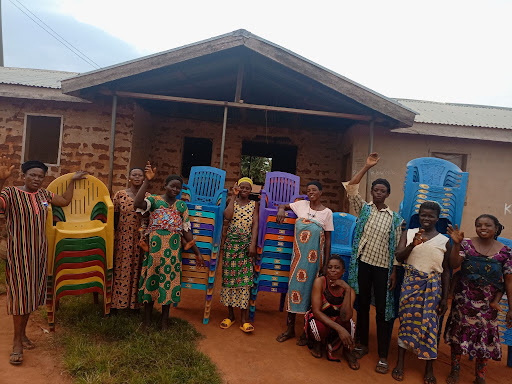
    (Savings group used their proceeds to purchase plastic chairs for hiring to raise additional funds to improve house hold income)

    These savings are kept safely in the savings box over a period of one year, after which the box is opened, and the proceeds are disbursed accordingly. Each member receives the amount he or she has saved over the year, plus a share of any additional contributions, fees assessed for violation of group rules, or interest charged for loans taken.


    When the program began, Kyeredeso had just one CSLA group, but that number has now grown to five savings groups – total membership of 150 community members – as people have seen the benefits.  “Having the ability to save is as important as being able to raise funds to deal with life circumstances,” said Nana Ama Nketia-Quaidoo, ACA’s Community Development Director. “These savings groups are helping to reduce financial stress and provide people with a greater sense of financial freedom.”

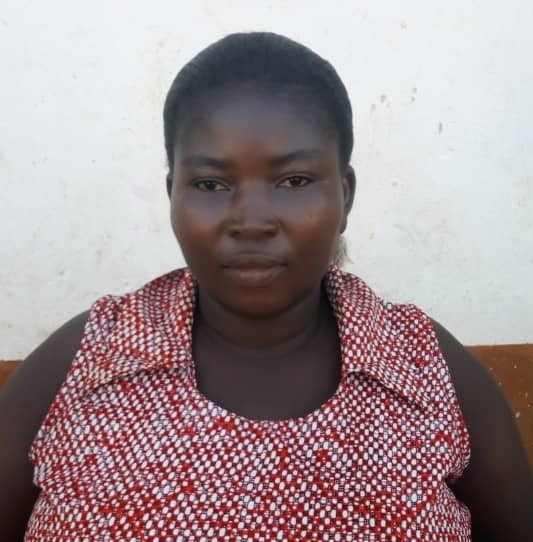
    The use of the CSLA to secure a lump-sum repayment of savings at the end of the year enables members to plan for seasonal purchases, important investments, or life-cycle events. For example, Puokuum Sumariinga is a widow with four children who has been struggling to feed her family and provide basic supports to her children’s needs since her husband’s demise. When she was introduced to the savings group, she made a pledge of GHS10 a week, although she was unsure whether she would be able to honor the commitment. Working menial jobs on other people’s farms, she managed to earn enough short-term income to save weekly. To date, Sumariinga has saved a total of 1,400 Ghana cedis, making her eligible for a low-interest loan from her CSLA. She used the loan proceeds to buy farm inputs to resuscitate her late husband’s farm, which will enable her to gain much more income and save more for her children’s education.

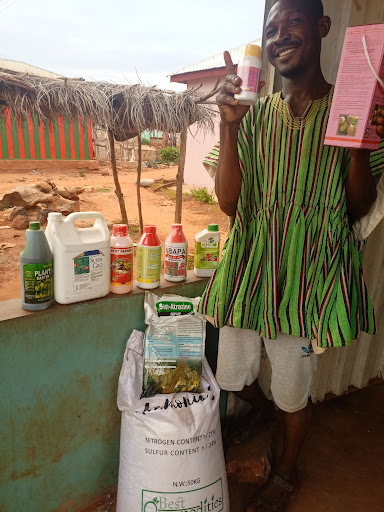
    (One community member who used his savings to purchase agriculture inputs to improve his livelihood)

    Mr. Amos Salensor, a Kyeredeso farmer, has also set his goals for savings – which currently total 2,550 Ghana cedis – based on his family’s needs. “My overall vision is to save enough to get a decent accommodation for my family and to be able to meet the educational needs of my children,” he explained.  “I hope to painlessly pay school fees and at least buy land to begin building in my next phase from the proceeds of the savings.”  Other CSLA group members report using the proceeds of their savings to venture into small businesses such as hiring out plastic chairs and petty trading, or to deal with unexpected downturns, for which they would have sought support from friends in the past.