Author: Richard

  • Asikam Maternity block nears completion

    Asikam Maternity block nears completion

    [et_pb_section fb_built=”1″ _builder_version=”4.18.1″ _module_preset=”default” global_colors_info=”{}”][et_pb_row _builder_version=”4.18.1″ _module_preset=”default” global_colors_info=”{}”][et_pb_column type=”4_4″ _builder_version=”4.18.1″ _module_preset=”default” global_colors_info=”{}”][et_pb_text _builder_version=”4.18.1″ _module_preset=”default” hover_enabled=”0″ global_colors_info=”{}” sticky_enabled=”0″]

    “We just can’t wait to witness the successful completion of this maternity block as it will go a long way to alleviate the pains our women go through in accessing ante-natal and post-natal health services”, Gideon Ofori Boakye, the Assembly member of Asikam.

    Asikam, a farming community in the Abuakwa South municipality of the Eastern region of Ghana, is leaving no stone unturned in completing its community-driven project under the Facilitated Collective Action Process (FCAP), which aims at strengthening decentralization process.

    Also called Oman yie die, the project is a partnership between Advocates for Community Alternatives (ACA), a non-profit-making organisation, which helps West African communities that are threatened by the destructive impacts of extractive projects to take control of their futures, and the Abuakwa South Municipal Assembly as part of measures to strengthen local participation in the implementation of the Assembly’s medium term development plan.

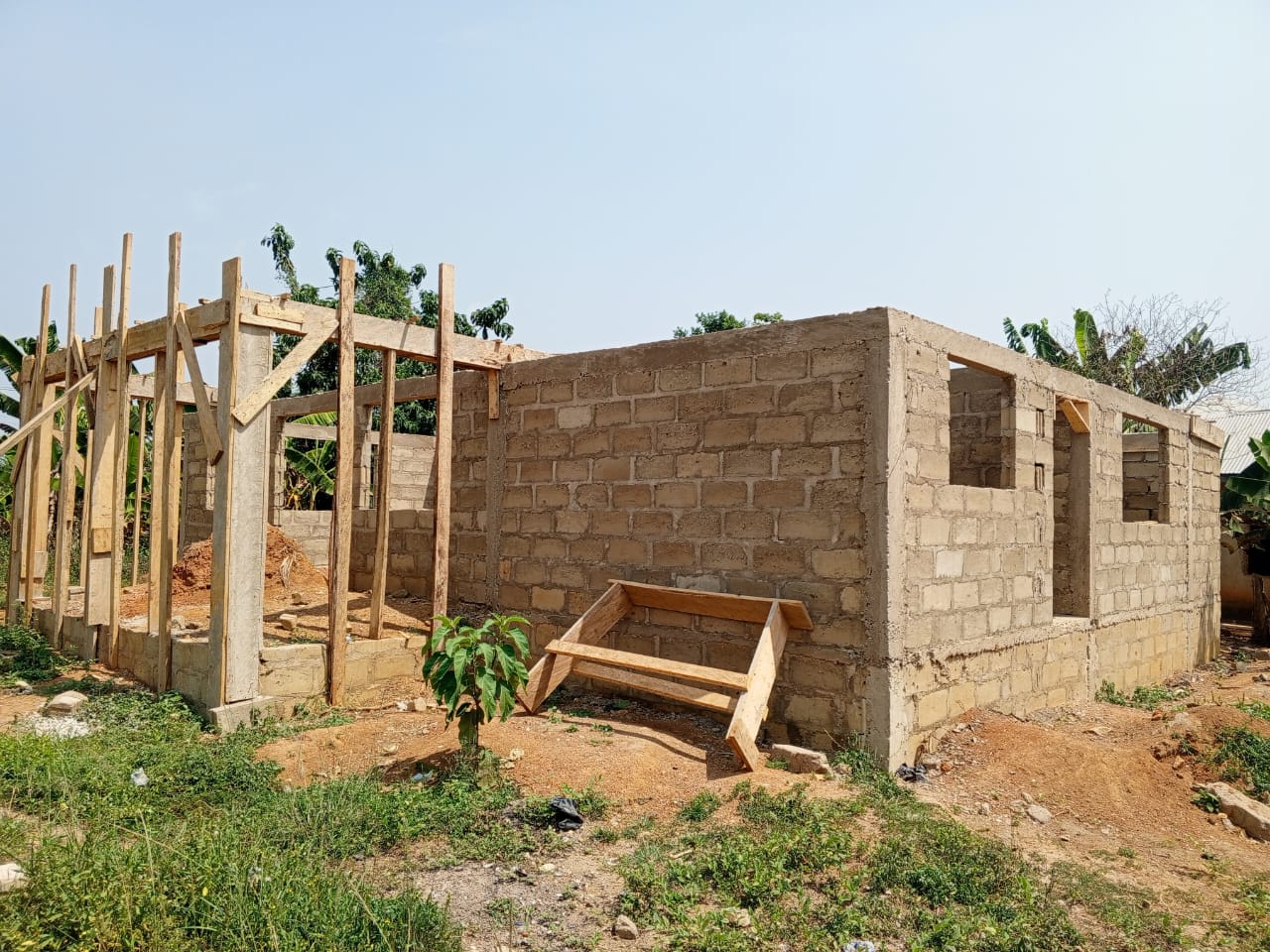
    With a $9,000 microgrant, the community members are putting up a Maternity block at a CHPS Compound in the town in partnership with ACA and the Abuakwa South Municipal Assembly. The community has so far spent approximately $4,500 of its microgrant.

    The project, which is about 60% complete, is primarily meant to augment health care delivery, especially with regards to maternal health services.

    “We’re done with the construction of the main building, and we’re left with a few works then we go to the roofing and plastering stages. So far, so good”, the Assembly member said in an interview.

    For Obed Ofori Ansah, the Mmranteεhene of Asikam (chief of young men): “This project is really coming at the right time because the practice where our women travel to Kyebi and sometimes to Koforidua for ante-natal and post-natal health services will soon be a thing of the past.”

    He is therefore calling on the residents of the town to continue with their communal assistance to ensure the timely completion of the project.

    The Asikam maternity block project at the lintel level

    [/et_pb_text][/et_pb_column][/et_pb_row][/et_pb_section][et_pb_section fb_built=”1″ _builder_version=”4.18.1″ _module_preset=”default” global_colors_info=”{}”][/et_pb_section]

  • Similimi residents triumph over Ivorian government in ECOWAS Court

    Similimi residents triumph over Ivorian government in ECOWAS Court

    [et_pb_section fb_built="1" _builder_version="4.18.1" _module_preset="default" global_colors_info="{}"][et_pb_row _builder_version="4.18.1" _module_preset="default" global_colors_info="{}"][et_pb_column type="4_4" _builder_version="4.18.1" _module_preset="default" global_colors_info="{}"][et_pb_image src="https://acaredesign.allmediagh.online/wp-content/uploads/2023/12/Eau-similimi-scaled-2.jpg" title_text="Eau similimi" _builder_version="4.18.1" _module_preset="default" global_colors_info="{}"][/et_pb_image][et_pb_text _builder_version="4.18.1" _module_preset="default" global_colors_info="{}"][/et_pb_text][/et_pb_column][/et_pb_row][et_pb_row _builder_version="4.18.1" _module_preset="default" global_colors_info="{}"][et_pb_column type="4_4" _builder_version="4.18.1" _module_preset="default" global_colors_info="{}"][et_pb_text _builder_version="4.18.1" _module_preset="default" hover_enabled="0" sticky_enabled="0"]

    Residents of Similimi, a village in northeastern Côte d’Ivoire, are celebrating a decision of the ECOWAS Court of Justice finding the Ivorian government culpable of human rights violations in connection with destructive manganese mining on their traditional lands.  At its sitting in Abuja on Thursday, November 30, 2023, the ECOWAS Court of Justice declared the Republic of Côte d’Ivoire guilty and ordered the government to pay 20 million CFA Francs each to eleven individual plaintiffs and to repair the environmental damage caused by the mining project.

     The Fight for Justice

     In the hope of obtaining justice, 14 representative inhabitants of Similimi, along with a communal self-help organization, filed a complaint in the ECOWAS Court of Justice in April 2020. The communities are supported by two member-organizations of the Public Interest Lawyering Initiative for West Africa (PILIWA), Advocates for Communities Alternatives (ACA) and Groupe pour la Recherche et le Plaidoyer sur les Industries extractives (in English, the Extractive Industries Research and Advocacy Group, known by its French acronym, GRPIE). The plaintiffs accused the Côte d’Ivoire of illegal expropriation, non-compliance with the rules of due diligence, and complicity in environmental, economic, and cultural damage.

    The Court’s November 30 ruling determines that the State is in fact responsible for violations of Similimi residents’ rights to a healthy environment, to health, to an adequate standard of living, to private and family life, and to freedom of worship and religion. The Court dismissed the Applicants’ claim that their right to property was violated, for lack of sufficient evidence of ownership.  “Even if the Court did not recognize our proprietary right to our ancestral lands, we are indeed happy that our voices were heard by a regional tribunal and that the suffering that we have endured over the years has not been in vain,” said Adou Kouamé, village chief of Similimi and a complainant.

    “We welcome this decision of the ECOWAS Court of Justice which recognized that the State of Côte d’Ivoire voluntarily facilitated and permitted the actions of BMSA, leading to the deterioration of the environment, causing health problems among residents, deteriorating the quality of water and air, destroying their crops and places of worship,” declared Mr. Rashidi Ibitowa, lawyer for the plaintiffs.

    Brief Background

    The inhabitants of Similimi, a village in the sub-prefecture of Bondoukou, about 430 km from Abidjan in the Republic of Côte d’Ivoire, mainly grew cashew nuts, fruits, legumes, and vegetables on their land before Bondoukou Manganèse SA (BMSA) began its operations. These lands were their sole form of economic support until the Ivorian government granted the company a mining concession in the area. The company soon began digging mining pits within a few hundred meters of the inhabited area of the village.

    Over more than a decade, the operations of BMSA have caused serious disruption to the lives of the people of Similimi. Improper disposal of waste products has polluted the waters, resulting in serious – and sometimes fatal – digestive disorders. Heavy vehicular traffic and extensive strip mining create constant dust and fumes, causing respiratory problems. The company’s land clearing activities have deforested the landscape and devastated places of worship, making residents’ traditional cultural practices impossible. And the noise of dynamite disrupts residents’ sleep and affects their mental health. Women are particularly affected, as the loss of natural resources undermines their social status and ability to provide for the basic needs of their families.

    Despite numerous complaints addressed to the mining company and the Ivorian authorities, the injuries and human rights violations have persisted without an effective remedy. The people of Similimi have requested repeatedly to be relocated away from the mine, but their prayers have gone unanswered.

    [/et_pb_text][/et_pb_column][/et_pb_row][/et_pb_section]
  • ACA ventures to promote public interest law in Nigeria

    [et_pb_section fb_built=”1″ theme_builder_area=”post_content” _builder_version=”4.18.1″ _module_preset=”default”][et_pb_row _builder_version=”4.18.1″ _module_preset=”default” theme_builder_area=”post_content”][et_pb_column _builder_version=”4.18.1″ _module_preset=”default” type=”4_4″ theme_builder_area=”post_content”][et_pb_text _builder_version=”4.18.1″ _module_preset=”default” theme_builder_area=”post_content” hover_enabled=”0″ sticky_enabled=”0″]

    With the help of Advocates for Community Alternatives (ACA), Nigerian lawyers are building new institutions that champion the fundamental human rights of West Africa’s poor and marginalized communities, especially those that are threatened by the destructive impacts of extractive activities. 

    [/et_pb_text][/et_pb_column][/et_pb_row][/et_pb_section][et_pb_section fb_built="1" theme_builder_area="post_content" _builder_version="4.18.1" _module_preset="default"][et_pb_row _builder_version="4.18.1" _module_preset="default" theme_builder_area="post_content"][et_pb_column _builder_version="4.18.1" _module_preset="default" type="4_4" theme_builder_area="post_content"][et_pb_image src="https://acaredesign.allmediagh.online/wp-content/uploads/2023/12/PILIWAN-3-1.jpeg" _builder_version="4.18.1" _module_preset="default" theme_builder_area="post_content" title_text="PILIWAN 3" hover_enabled="0" sticky_enabled="0"][/et_pb_image][/et_pb_column][/et_pb_row][/et_pb_section][et_pb_section fb_built="1" theme_builder_area="post_content" _builder_version="4.18.1" _module_preset="default"][et_pb_row _builder_version="4.18.1" _module_preset="default" theme_builder_area="post_content"][et_pb_column _builder_version="4.18.1" _module_preset="default" type="4_4" theme_builder_area="post_content"][et_pb_text _builder_version="4.18.1" _module_preset="default" theme_builder_area="post_content" hover_enabled="0" sticky_enabled="0"]

    At the beginning of November 2023, ACA signed Memoranda of Understanding with three such institutions – the Public Interest Lawyering Initiative for West Africa’s Nigeria Chapter (PILIWAN), Caleb University College of Law (COLAW) in Lagos, and the Nigeria Bar Association Port Harcourt Branch (NBA-PHB) – to boost public interest law and representation.

    Legal Clinic at COLAW

    ACA, PILIWAN, and COLAW have agreed to collaborate to launch a public interest legal clinic at COLAW by March 2024.  Clinical students will gain practical experience of the law while contributing to concrete public interest cases – in other words, they will learn by doing, while doing good. 

    ACA will provide curriculum, guest instructors, strategic guidance, and some financial support for the clinic’s operations.  PILIWAN will also collaborate on curriculum and guest instructors, provide opportunities for practical learning, and coordinate fieldwork, while COLAW will host the law school, provide basic instruction, and propose further opportunities for collaboration (such as research endeavors).

    Public Interest Litigation Desk at NBA-PHB

    A new partnership between ACA, PILIWAN, and the Nigerian Bar Association (NBA) centers on a public interest litigation desk, to be hosted at the NBA’s Port Harcourt Branch.  This collaboration will create a space where individuals and communities threatened by powerful economic actors can be connected to lawyers who will support their struggle.

     “This partnership with Nigeria Bar Association is to strengthen the public interest work they do, especially the human rights aspect of it”, said Courage Nsirimovu, PILIWA Nigeria South-South Coordinator and Founder of Pilex Centre for Civic Engagement.

    “They have limited resources, so they need encouragement.  This collaboration will help the NBA Human Rights Committee to do more. We want them to do more so we can help indigent persons who do not have the opportunity to get access to justice”.

    Jonathan G. Kaufman, the Executive Director of ACA, explained, “We are trying to bring to West African countries the idea that the law is an instrument for social justice.  This means that lawyers and the Bar can use the law to help make life better for communities, and individuals.  Being a lawyer is not just about greasing the wheels of the society and serving the interests of the rich and powerful.”

    “That is what this partnership between ACA, PILIWA, and the NBA is all about.  Using law for social justice can mean so many things, like fighting for environmental justice when there is an oil spill, representing people who are wrongfully imprisoned, standing up for women whose rights have been downtrodden or subjected to abuse and seeking to change reality for them.  Human rights include all the things people need to live a dignified and reasonable life, and we hope the public interest litigation desk will help marginalized Nigerian communities to secure these rights.”

    PILIWAN is the Nigerian national chapter of the Public Interest Lawyering Initiative for West Africa (PILIWA), a network of lawyers, law firms, and non-profits in nine West African countries that promote public interest law and representation for marginalized and threatened communities. 

    Advocates for Community Alternatives (ACA) is a Ghana-based non-profit organization that helped West African communities that are threatened by the destructive impacts of extractive projects to take control of their own future, through a combination of community-driven development support and community-based legal and advocacy programming.


    [/et_pb_text][/et_pb_column][/et_pb_row][/et_pb_section]
  • Aggah community puts Eni’s word to test in court

    [et_pb_section fb_built=”1″ theme_builder_area=”post_content” _builder_version=”4.18.1″ _module_preset=”default”][et_pb_row _builder_version=”4.18.1″ _module_preset=”default” theme_builder_area=”post_content”][et_pb_column _builder_version=”4.18.1″ _module_preset=”default” type=”4_4″ theme_builder_area=”post_content”][et_pb_text _builder_version=”4.18.1″ _module_preset=”default” theme_builder_area=”post_content” hover_enabled=”0″ sticky_enabled=”0″]

    Aggrieved community members of the Nigerian town of Aggah have taken Italian energy giant, Eni S.p.A., and its subsidiary, Nigerian Agip Oil Company Ltd. (NAOC), to court in Italy for relief from floods that have caused damage to the people’s lives and property for decades.

    Brief Background

    Aggah is a community in the western part of Rivers State, Nigeria, with a population of about 10,000. Its residents traditionally make their living as farmers and fishermen.

    In the early 1970s, Eni/NAOC created 40,000 ft2 earthen embankments at three locations near Aggah to support wellheads and constructed raised access roads to connect them. These constructions completely blocked the natural course of streams that flowed through the Aggah community and its environs.

    Because adequate measures were not put in place to channel the water, the streams backed up and flooded large swathes of Aggah’s farmlands and residential areas each year, typically during the rainy season.

    Over the course of several decades, Aggah residents and community leaders have contacted Eni/NAOC repeatedly in hopes of resolving the flooding and its impacts. However, these attempts to seek relief have been to no avail. Community members and even the Rivers State Ministry of Environment sued the company on several occasions; while those attempts have on some occasions led to judgments against the company or settlement agreements with individual families, the flooding situation remains unremediated.

    The Italian OECD Complaint and 2019 Settlement Agreement

    In December 2017, Egbema Voice of Freedom – a local community group representing hundreds of Aggah residents – Nigerian law firm Chima Williams and Associates, and Advocates for Community Alternatives (ACA) filed an NCP complaint with Italian and Dutch National Contact Points (NCPs) for the OECD Guidelines for Multinational Enterprises.  The NCPs, which are offices located in the governments of the mostly wealthy countries that belong to the Organization for Economic Cooperation and Development, are charged with helping to resolve disputes between companies and the people and communities affected by their operations, arising from the failure to respect high social and environmental standards.

    In June 2019, the parties reached a settlement: the Eni/NAOC agreed to build “new culverts/drainages” and to work with the complainants to take any further necessary steps to ending the annual flooding.

    NAOC then hired contractors who built new culverts through the access roads. These constructions, however, were poorly designed and shoddily executed, according to an independent report that NAOC suppressed. The company has disavowed any responsibility to take further measures to lift the floods, insisting (against the findings of its own technical experts) that the natural marshy environment of the Niger Delta is to blame. Consequently, the flooding continues to wreak destruction on Aggah community every year.

    Fresh suit against Eni

    Having reached an impasse in its negotiations with Eni/NAOC, the complainants from the OECD process have filed a lawsuit at the Tribunal of Milan in Italy. Represented by Studio Legale Dini-Saltalamacchia, the aggrieved Aggah community members are asking the court to enforce the settlement agreement with Eni by requiring Eni and NAOC to take all necessary steps to lift the floods in Aggah. The community members are also seeking damages for the loss of lives, livelihoods and properties over the years due to Eni’s floods.

    Disappointed Community Members Hope for Justice

    One of the flood victims and a native of Aggah is Mrs. Sandra Ubah. She says she is “highly impressed with the case because NAOC has refused to keep to agreement and the last hope of the common man. Again, the issue of Eni/NAOC human right violation will be addressed.”

    “My expectations in the trial in Italy is to get justice served on our side because the injustices and human right violations we suffer at the hands of the Italian company are numerous, including deaths, strange diseases, etc., and so I am confident that the case will favor us because the court is the place of justice.”

    For Mrs. Victoria Elechi, another resident, it is impressive that Eni/NAOC are being hauled before an Italian court as this is a good step in seeking justice for the people.

    “I am expecting justice for our people. We have suffered a lot of injustices and human rights violations in the hands of the company. E.g., refusal to lift the blockage of water right of way caused by Eni’s facility, which has caused a lot of damage like building collapse, sicknesses and diseases, deaths, etc. I have confidence because the court, as last hope of the common man, will give us justice at last.

    “This suit that has just been filed in Milan court in Italy would give hope to victims of human rights violations everywhere, especially in West Africa,” said Lalla Touré, ACA’s Legal Director. “We’re counting on the Italian legal system to help ensure that the fundamental human rights of Aggah community members are upheld.”

    “It is so shocking that a multi-national organisation like Eni would be living in disobedience to an outcome of an agreement which they willingly signed before the Italian and Dutch governments and then turn around and deceive the world. Eni has operated on our land for over sixty years in this manner. They don’t care about our lives, our environment and source of livelihood. Eni take oil, we pay with our lives.  Eni lives in disobedience to both natural and constituted laws in our land and to me this is genocide,” Pastor Evaristus Nicholas, the leader of Egbema Voice of Freedom said after the case had been filed in Italy.

    “I’m expecting nothing but justice for me and my people, just the same way it was given to us before the Italian and Dutch NCP, but Eni refused to obey, which is why we have come before the Italian judiciary to get the backing of the law.”

    ———————————————————————————————————————

    Advocates for Community Alternatives (ACA) – ACA helps West African communities that are threatened by the destructive impacts of extractives-led development to take control of their own futures. ACA works directly with communities to design their own sustainable development plans and advocate to achieve those plans, and it builds and supports networks of lawyers and other professionals that will serve communities in need. ACA is providing strategic legal support to MDT as part of their participation in the Public Interest Lawyering Network for West Africa (PILIWA), which ACA coordinates.

    Chima Williams & Associates (CWA) – CWA is a public interest law firm based in Benin City, Edo State, Nigeria, that supports communities in the Niger Delta in cases involving human rights and environmental abuses, particularly by oil companies.

    Egbema Voice of Freedom (EVF) – EVF is a community-based organization in Aggah Community in Rivers State, Nigeria, that was formed to represent the people of Aggah in the defense of their human rights, especially with respect to the oil extraction operations of Eni/NAOC in and around their territory.

    END

    Media Contacts

    1. ACA: Lalla Toure, Legal Director: lalla@advocatesforalternatives.org”lalla@advocatesforalternatives.org | +233 50 985 0018
    2. CWA: Chima Williams, Principal Attorney: princewchima@yahoo.co.uk”princewchima@yahoo.co.uk |+234 802 364 9890
    3. Egbema Voice of Freedom: Pastor Nicholas Evaristus: royalgraceassembly_evarist@yahoo.com”royalgraceassembly_evarist@yahoo.com | +234 806 432 9322

    Your content goes here. Edit or remove this text inline or in the module Content settings. You can also style every aspect of this content in the module Design settings and even apply custom CSS to this text in the module Advanced settings.
    [/et_pb_text][/et_pb_column][/et_pb_row][/et_pb_section]
  • ACA, Fanteakwa South jointly open soap-making business at Juaso

    [et_pb_section fb_built=”1″ theme_builder_area=”post_content” _builder_version=”4.18.1″ _module_preset=”default”][et_pb_row _builder_version=”4.18.1″ _module_preset=”default” theme_builder_area=”post_content”][et_pb_column _builder_version=”4.18.1″ _module_preset=”default” type=”4_4″ theme_builder_area=”post_content”][et_pb_text _builder_version=”4.18.1″ _module_preset=”default” theme_builder_area=”post_content” hover_enabled=”0″ sticky_enabled=”0″]

    “Here in Juaso, we have lost almost all our farmlands to mining activities, thereby creating food insecurity in this area. By working at this soap-making mini-factory, I will make some income and be better positioned to fend for my dependents. Even though I’m a seamstress, business has taken a nose-dive in recent times and so this soap-making venture, for me, is very timely as it will go a long way to help me cater for my children and family.”

    Madam Mary Nyarkoa is a witness to the wanton destruction of farmlands in Juaso near Osino in the Fanteakwa South District of the Eastern Region of Ghana by mining companies and laments the adverse impact of mining activities in the area on food production and the livelihoods of her compatriots.

    She recounts that foodstuff such as cassava and plantain, which used to be in abundance prior to the advent of mining activities in the area, are now scarce, thereby heightening their prices on the market – a situation which has brought untold economic hardships on various households in Juaso.

    There is, however, a new day that has dawned on her and other community members of Juaso as they can now boast of a black soap-making business, which builds on and adds value to the community’s traditional cocoa and plantain-growing livelihoods and promises positive prospects for the entire community.

    The black soap project uses the discarded parts of the cocoa and plantain that they traditionally grow in Juaso, so it is a sustainable project that promotes preservation of farmland and the precious Atiwa Forest ecosystem that Juaso is part of.

    Collaboration

    The Juaso soap mini-factory is a collaboration between the Fanteakwa South District Assembly and Advocates for Community Alternatives (ACA), a non-profit-making organisation that helps West African communities that are threatened by the destructive impacts of extractive projects to take control of their own future.

    This black soap facility is the project that Juaso chose to implement through the Facilitated Collective Action Process (FCAP), an intensive engagement between ACA and the Juaso Community during which the community received financial and capacity building support to implement a project that would further the community’s sustainable development vision.  Kaeme Cosmetics Limited, a high-end Ghanaian body product company, provided technical support and training to the community and a guaranteed market for their product.

    “I can say with confidence that this soap production business has a bright future because as we speak, it is the only soap factory in our district (Fanteakwa South) and so we already have a huge market to do business. I’m sure we will expand to serve other nearby communities and districts. It will get to a time that we may have to engage more people, thereby creating employment opportunities for others, so we really have a good future”, Madam Nyarkoa further said.

    “We have witnessed a lot of positive developments in our lives since ACA began its work here at Juaso. Even before this soap-making venture, they educated and assisted us to develop a savings habit through “susu box” concept and so now that this soap-making business has finally taken off, …. Even though we have just started operations we are positive that it will really cushion our lives financially.”

    Sustainable income

    53-year-old Elizabeth Wayoe, who is also one of the initial 28 workers of the factory, says she can heave a sigh of relief because she now is sure of a sustainable income, which will cushion her life in many ways.

    “I know for sure that if I commit myself to this work, I stand to gain in many ways because apart from the financial rewards I will be getting from this job, I will no more be buying soap since we (as workers) are given some pieces of the soap for use at home”, she said.

    The Juaso soap factory commenced operations on Friday, 6th October 2023 and has been producing raw organic black soap in commercial quantities.


    [/et_pb_text][/et_pb_column][/et_pb_row][/et_pb_section]